What Happens If You Delay Recommended Spine Surgery?
It depends on why surgery was recommended. If your spine surgery is meant to relieve pain from a stable condition, such as a herniated disc without neurological loss, you can often wait while you try other treatments. If it is meant to relieve pressure on the spinal cord or nerves that is causing weakness, numbness, or balance problems, waiting can allow nerve injury to progress, and some of that damage may not fully recover.
The most important step is to find out which situation you are in. Dr. Ramsis Ghaly, a board certified neurosurgeon in Aurora, IL, reviews your symptoms and MRI or CT imaging to give you a clear answer. Request an appointment or call 630-978-6143.
Why Spine Surgery Is Recommended in the First Place
Spine surgery is usually recommended for one of three reasons:
- To relieve pressure on nerves or the spinal cord, such as with a herniated disc, spinal stenosis, or a bone spur.
- To stabilize the spine, such as with spondylolisthesis or an unstable segment.
- To stop or prevent neurological decline, such as worsening weakness or loss of coordination.
Surgery is not automatically the first answer for back or neck pain. Many spine conditions are first managed with physical therapy, medication, activity changes, or injections. Surgery is typically considered when those measures fail or when there is progressive neurological compromise. The reason your surgeon gave for recommending surgery largely determines how much time you have.
When Delaying Spine Surgery May Be Reasonable
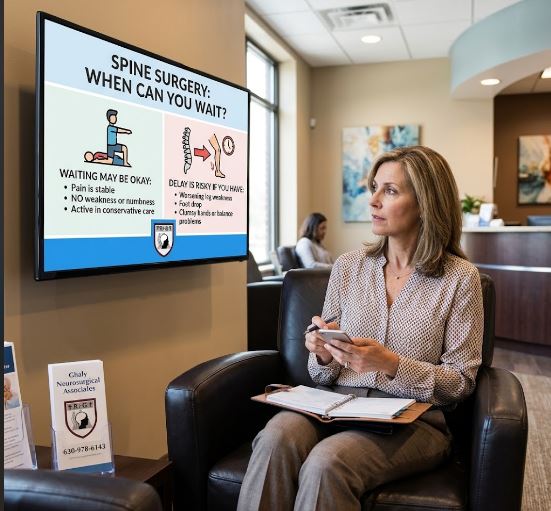
Waiting can be a legitimate, medically sound choice when all of the following are true:
- Your symptoms are mainly pain, not new weakness or loss of function
- Your neurological exam is stable
- Your imaging does not show severe compression of the spinal cord
- You are actively trying nonsurgical treatment and your surgeon agrees it is reasonable
- Your symptoms are stable or improving
Many people with a herniated disc or stenosis and no neurological deficits can safely pursue conservative care first. A responsible surgeon should tell you this, and should also tell you what would change the plan.
What Can Happen When You Delay Surgery You Truly Need
When surgery is recommended because a nerve or the spinal cord is under pressure, the risks of waiting include the following.
1. Nerve damage that does not fully recover
Nerves and the spinal cord tolerate pressure for only so long. Long-standing compression can cause lasting changes, and recovery after decompression may be less complete than if the pressure had been relieved earlier.
2. Worsening weakness or numbness
Mild symptoms can progress to noticeable weakness, such as a foot that drags, a weak grip, or difficulty with stairs. Recovery of strength is not guaranteed once it has been lost for a long time.
3. Progressive cervical myelopathy
When the spinal cord in the neck is compressed (cervical myelopathy), symptoms can include clumsy hands, trouble with buttons or handwriting, imbalance, and a changing walk. Research on cervical myelopathy has linked longer symptom duration before surgery with poorer results, including a large multicenter analysis that found worse outcomes when surgery was delayed 12 months or more. Other research has pointed to the first several months as especially important.
4. Chronic pain that becomes harder to treat
Pain that persists for a long time can change how your body processes it, and it can limit sleep, work, and activity. Ongoing pain does not always mean surgery is urgent, but untreated, disabling pain is a reason to get an evaluation rather than keep waiting.
5. A condition that becomes more complex
A degenerative spine condition can progress. In some cases, a problem that once needed a limited procedure may later require a more extensive one. This is not true for everyone, which is why imaging and follow-up matter.
6. Loss of independence and quality of life
Delay can also mean months of reduced activity, missed work, falls, and deconditioning, which can make recovery harder if surgery eventually becomes necessary.
Spine Surgery Timing by Condition
| Condition | Can It Often Wait? | When Waiting Becomes Risky |
|---|---|---|
| Herniated disc with leg pain | Often, with conservative care | Progressive weakness, foot drop, or pain that is not controllable |
| Lumbar spinal stenosis | Often, if symptoms are stable | Worsening walking ability or leg weakness |
| Spondylolisthesis | Sometimes | Instability, progressive slippage, or nerve compression symptoms |
| Cervical myelopathy (spinal cord compression in the neck) | Usually not for long | Any worsening hand clumsiness, balance, or gait problems |
| Cauda equina syndrome | No, this is an emergency | Bladder or bowel changes, saddle numbness, rapidly worsening leg weakness |
This table is general information, not a diagnosis. Your timeline depends on your own imaging and exam.
Red-Flag Symptoms: Do Not Wait
Seek emergency medical care right away, rather than waiting for a routine appointment, if you have:
- New loss of bladder or bowel control
- Numbness in the groin or inner thighs (saddle numbness)
- Rapidly worsening weakness in an arm or leg
- Sudden difficulty walking or loss of balance
- Severe pain with fever, or pain after significant trauma
These can signal a spinal emergency, and treatment is time-sensitive.
Signs You Should Schedule a Spine Evaluation Soon
Book a consultation promptly, even if you are not in an emergency, if you notice:
- Numbness or tingling that is spreading or not going away
- Mild but increasing weakness in a hand, arm, leg, or foot
- Dropping objects or losing fine hand control
- Walking changes or frequent tripping
- Pain that keeps you from sleeping, working, or daily activities
- Symptoms that persist or worsen despite physical therapy, medication, or injections
Dr. Ghaly’s team can review your concerns in person in Aurora or by telehealth.
Why People Delay Spine Surgery (and How to Think It Through)
Delaying is understandable. Common reasons include:
- Fear of surgery or complications. Weigh this against the risks of the untreated condition, and ask your surgeon to explain both.
- Doubt about the diagnosis. If you are unsure, a second opinion is a reasonable step. See our guide on whether getting a second opinion is a good idea.
- Work, family, or caregiving demands. Ask what a realistic timeline looks like and what planning can reduce disruption.
- Insurance or cost concerns. Ask the office about the approval process before assuming it is out of reach.
- Hoping it will get better on its own. Some conditions do improve. Set a clear checkpoint with your surgeon, and know which symptoms mean you should come back sooner.
Hesitation is not the problem. Waiting without a plan is.
Questions to Ask Your Surgeon About Timing
- What exactly is causing my symptoms, and what do my images show?
- Is there pressure on my spinal cord or nerves?
- What is the realistic timeframe for deciding?
- What happens if I wait three months, six months, or a year?
- What nonsurgical options are reasonable, and for how long?
- Which symptoms mean I should call you right away?
- How will you monitor me while I wait?
How a Second Opinion or Records Review Can Help You Decide
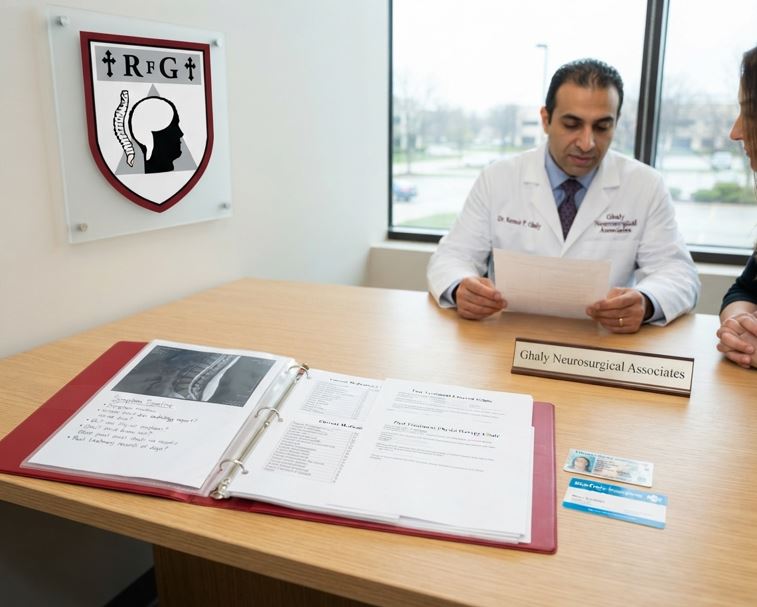
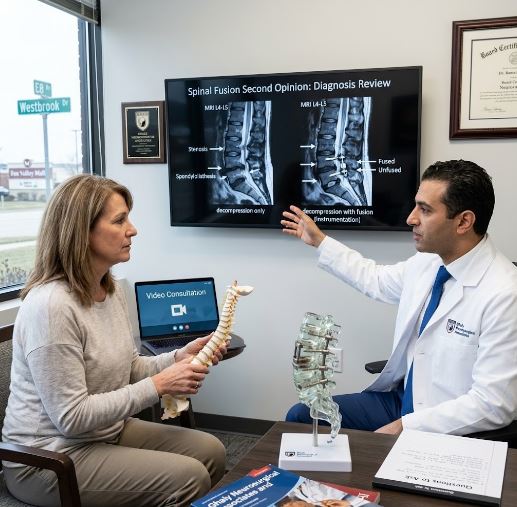
If you have been told you need surgery and are unsure about the urgency, an independent review can clarify whether surgery is needed now, later, or not at all. Dr. Ghaly reviews your imaging, records, and prior recommendations, and discusses both surgical and nonsurgical paths. You can start with a medical records review, which you can submit without traveling first, and learn more in our article on what happens during a medical records review. A second opinion can also confirm, refine, or change a diagnosis.
Spine Surgery Options Dr. Ghaly Performs
Depending on your diagnosis, Dr. Ghaly performs cervical laminectomy, lumbar disc surgery, and spinal fusion, using minimally invasive techniques when your condition and anatomy allow. Learn more on the spinal surgery page. Minimally invasive surgery is not right for every patient, and your imaging and exam determine the safest approach.
Get Clarity Before Your Condition Changes
If you have been putting off a spine surgery decision, you do not have to decide alone or in the dark. Dr. Ghaly will review your symptoms and imaging, explain whether your situation can safely wait, and lay out your options.
Ghaly Neurosurgical Associates
4260 Westbrook Dr., Suite 127, Aurora, IL 60504 (Fox Valley Office Commons, near the Fox Valley Mall)
Phone: 630-978-6143 or 630-578-7500
Hours: Monday to Friday, 9:00 AM to 5:00 PM (weekends by request)
Request an Appointment | Learn About Dr. Ghaly
Patients from Aurora, Naperville, and the greater Chicago area are seen in person, and patients nationwide can connect through telehealth and remote second opinions.
FAQs
What happens if you wait too long to have spine surgery?
If surgery is recommended to relieve pressure on a nerve or the spinal cord, waiting too long can allow nerve damage to progress, causing worsening weakness, numbness, balance problems, or chronic pain. Some of that damage may not fully recover. If your condition is stable and not compressing neural structures, waiting is often less risky.
How long can you safely put off spine surgery?
There is no single time limit. It depends on your diagnosis, your symptoms, and your imaging. Some stable conditions can be monitored for months while you try conservative care, while spinal cord compression or progressive weakness may call for prompt evaluation. Your surgeon can give you a timeline based on your case.
Can delaying spine surgery cause permanent damage?
It can, in cases where nerves or the spinal cord are compressed. Prolonged pressure may cause lasting changes, and recovery after surgery can be less complete the longer symptoms have been present. This is why new or worsening neurological symptoms should be evaluated quickly.
What symptoms mean I should not wait for spine surgery?
Loss of bladder or bowel control, saddle numbness, rapidly worsening weakness, and sudden walking or balance problems need emergency care. Spreading numbness, increasing weakness, or loss of hand coordination should prompt a prompt visit to a spine specialist.
Is it dangerous to delay back surgery for a herniated disc?
Often it is not, if you have pain without significant weakness and are trying conservative treatment. It becomes more concerning if you develop progressive leg weakness, foot drop, or bladder or bowel changes.
Can spinal stenosis get worse if I don’t have surgery?
Spinal stenosis is degenerative and can progress in some people, while others stay stable for long periods. Worsening walking ability, increasing weakness, or new numbness are reasons to be reevaluated.
Is it okay to get a second opinion before spine surgery?
Yes. A second opinion can help you confirm the diagnosis, understand how urgent surgery really is, and weigh nonsurgical options. Dr. Ghaly offers second opinions in person and remotely.
Can I have a spine consultation by telehealth?
Depending on your location and case, Dr. Ghaly’s office can arrange a telehealth consultation to discuss your history and imaging before any in-person exam.
This article is for general education and is not a substitute for medical advice, diagnosis, or treatment. Your timeline depends on your individual condition. If you have a medical emergency, call 911 or go to the nearest emergency department.