
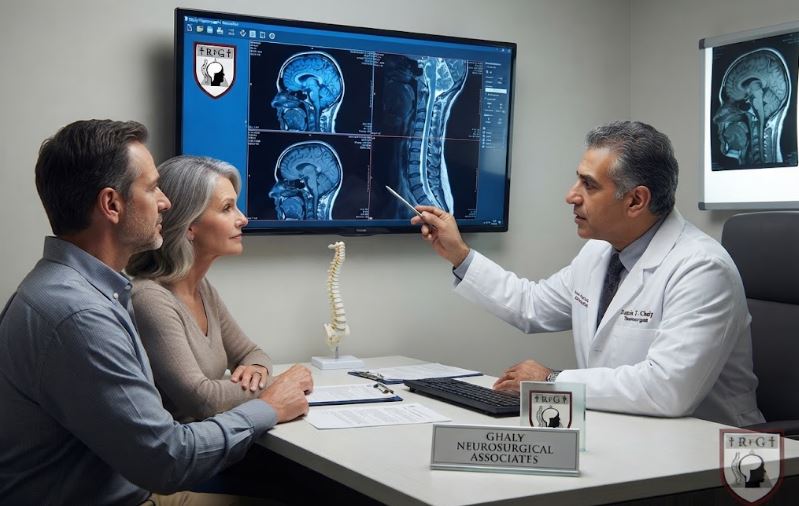
Is Getting a Second Opinion a Good Idea Before Brain or Spine Surgery?
Yes. A second opinion is a good idea when you’re facing major surgery, an unclear diagnosis, or a recommendation that doesn’t feel fully explained. It can confirm your plan, refine it, or point to a different approach. The main exception is a true emergency, where delay could cause harm.
If you’ve just been told you may need brain or spine surgery, you’re probably juggling fear, questions, and a lot of pressure to decide quickly. Asking another specialist to look at your case is a normal, responsible step. It doesn’t mean you distrust your doctor. It means a decision that affects your nervous system deserves a careful look.
Below is when a second opinion helps most, what the research says, when not to wait, and how to get one. At Ghaly Neurosurgical Associates in Aurora, IL, Dr. Ramsis F. Ghaly offers neurosurgical second opinions in person and online.
When Is a Second Opinion a Good Idea?
For routine care, you probably don’t need one. For major decisions, it’s often worth the time. Consider one if:
- You’ve been told you need surgery. Spinal fusion, craniotomy, laminectomy, and similar procedures carry real risks and recovery demands.
- You feel rushed. A planned operation should leave room for questions. Pressure to commit immediately is a reason to pause.
- You haven’t explored non-surgical options. Many spine and nerve conditions are first managed without surgery, and you should know what was considered.
- Your diagnosis is unclear or doesn’t match your symptoms.
- You’ve been told you have “no options” or an “inoperable” condition. Another surgeon may assess the same imaging differently.
- You’ve received conflicting recommendations from different providers.
- Your insurance directs you to a specific provider and you want an independent opinion.
- A second operation is being recommended after a previous procedure.
What Does the Research Say?
The best-known data comes from a Mayo Clinic study of 286 patients referred for a second opinion on complex conditions. The final diagnosis matched the referring diagnosis in only 12% of cases. It was refined in 66% and completely changed in 21%.
This study looked at complex general internal medicine referrals at one academic center, not neurosurgery specifically, and it can’t predict what will happen in your case. It does show why a fresh look at a difficult diagnosis can matter.
What a Second Opinion Can Tell You
| Possible outcome | What it means for you |
| Confirms the first opinion | You can move forward with more confidence. |
| Refines the diagnosis or plan | You may learn more about the exact cause, the type of procedure, or the approach. |
| Offers a different recommendation | You may hear about non-surgical options, a different timing, or a different procedure. |
| Identifies missing information | You may learn that additional imaging or records are needed before deciding. |
Even when the second opinion agrees with the first, you gain clarity about why the recommendation makes sense.
When Not to Wait: Get Urgent Care First
Many brain and spine surgeries are planned rather than emergency procedures, which usually leaves time to get another opinion. But some situations should not wait. Call 911 or go to the nearest emergency room for:
- New loss of bladder or bowel control
- Numbness in the groin or inner thighs
- Rapidly worsening weakness in an arm or leg
- A sudden, severe headache unlike any you’ve had
- A new seizure, sudden confusion, trouble speaking, or sudden vision changes
If your surgeon has told you a procedure is urgent, ask directly: “What happens if I wait two to three weeks to get another opinion?” A good surgeon will give you a clear, honest answer.
Will My Doctor Be Offended?
Second opinions are expected in serious medical decisions. You can say something simple: “This is a major decision, and I’d like another specialist to review my imaging before I commit.” You can also ask your doctor or their office to send your records ahead.
If a provider reacts badly to a reasonable request, that is useful information in itself.
Second Opinions by Condition
Spine Surgery
Spinal fusion, microdiscectomy, decompression, and cervical or lumbar procedures are common second-opinion requests. Ask whether the surgery targets the actual source of your symptoms, and what a realistic recovery looks like. See Dr. Ghaly’s approach to spinal surgeries.
Brain Surgery
A second opinion can be valuable for brain tumors, aneurysms, Chiari malformation, and other conditions where surgical approach and timing matter. Learn more about brain surgery with Dr. Ghaly.
Peripheral Nerve and Carpal Tunnel Surgery
If you’ve been told you need a carpal tunnel or ulnar nerve procedure, a second opinion can clarify whether surgery is the right step and which technique fits your case. See carpal tunnel surgery.
What If the Second Opinion Disagrees With the First?
Two qualified surgeons can see the same case differently. Before choosing a side:
- Ask each surgeon to explain why they recommend their approach, in plain language.
- Ask what the other approach would involve, and why they would or wouldn’t choose it.
- Compare risks, recovery, and the chance of needing further treatment.
- Notice who explains clearly, answers questions without defensiveness, and lays out nonsurgical options.
- If the opinions differ sharply, such as different diagnoses or entirely different operations, a third opinion may be worth considering.
Questions to Ask Any Surgeon Before You Decide
- What is my exact diagnosis, and what does my imaging show?
- What happens if I don’t have surgery, or wait?
- What non-surgical options exist, and why are they or aren’t they right for me?
- What are the main risks, and what are realistic outcomes?
- What does recovery look like, and when could I return to normal activities?
- How often do you perform this procedure?
- Is there another approach you considered and ruled out?
How to Get a Neurosurgical Second Opinion
- Request your records. Ask your doctor, hospital, and imaging center for your reports and the actual scans (MRI, CT, X-ray), not just the written summaries.
- Gather your history. List your symptoms, treatments tried, current medications, and prior surgeries.
- Write down your questions. Include what the first surgeon recommended and why.
- Choose a format. In person, online, or a records-only review (see below).
- Bring the opinion back to your care team. Share the results with your primary doctor.
In-Person, Virtual, or Records Review: Which Is Right for You?
| Option | Best for | Insurance note |
| In-person second opinion | Cases where a physical exam matters; patients near Aurora, Naperville, and Chicagoland | Typically billed through insurance like a standard visit; confirm with the office |
| Virtual second opinion / telehealth | Patients who can’t travel, or who want expert input before deciding on an in-person visit | Generally an out-of-pocket service, not billed through insurance |
| Medical records review | Complex histories, conflicting opinions, or missing records | Out-of-pocket service |
A virtual visit is effective for reviewing history and imaging, but new or rapidly changing symptoms are generally best evaluated in person. Dr. Ghaly’s team can help you choose the right format.
Insurance and Your Right to Choose
Coverage varies by plan. It helps to review your policy for provider requirements and out-of-network benefits before assuming you’re limited to one surgeon’s opinion. Some plans cover second opinions, and some may require them for certain procedures. If your plan restricts in-person providers, a virtual option may still be available out of pocket. Call the office and ask before your visit.
A Second Opinion With Dr. Ghaly in Aurora, IL
Dr. Ramsis F. Ghaly is a board certified neurosurgeon and clinical professor who treats brain, spine, and peripheral nerve conditions. He is a Diplomate of the American Board of Neurological Surgeons, with additional credentials in anesthesiology, neurocritical care (UCNS), and pain medicine.
His approach is to explain your condition clearly, review your imaging and history in detail, discuss all reasonable options including nonsurgical ones, and recommend surgery only when it’s the right choice. Dr. Ghaly personally reviews your imaging and history before your consultation.
Our office is at Fox Valley Office Commons, 4260 Westbrook Dr., Suite 127, Aurora, IL 60504, serving patients in Aurora, Naperville, and the greater Chicago area, with remote options for patients across the country and internationally. Read more about Dr. Ghaly or hear from patients.
Ready for a clearer picture before you decide? Request a second opinion appointment or call 630-978-6143 (new patients, press 0). Office hours are Monday to Friday, 9:00 AM to 5:00 PM.
FAQs
Is getting a second opinion a good idea?
Yes, especially before major surgery, with an unclear diagnosis, or when you’ve been told you have limited options. It can confirm your plan, refine it, or reveal alternatives. The exception is an emergency, where delay could cause harm.
Will getting a second opinion delay my treatment?
It may add some time, but many brain and spine procedures are planned rather than emergencies. If your surgeon says your case is urgent, ask what a short delay would mean for you.
Will my surgeon be offended?
Second opinions are an expected part of major medical decisions, and you can ask your doctor to send your records to the second specialist.
Do I need a referral to see Dr. Ghaly for a second opinion?
No referral is required, though bringing your records and imaging makes the consultation more thorough.
Will insurance cover a second opinion?
It depends on your plan. In-person second opinions are typically billed through insurance like a standard visit, while virtual second opinions are generally out of pocket. Contact our office to confirm.
Can I get a neurosurgical second opinion online?
Yes. Dr. Ghaly offers virtual second opinions by secure video, plus an online medical records review. Some conditions are best evaluated with a physical exam, and the office will tell you if an in-person visit is recommended.
What should I bring to a second opinion?
Your MRI, CT, or X-ray images and reports, a medication list, your treatment history, and the first doctor’s recommendation.
What if the second opinion is different from the first?
Ask each surgeon to explain their reasoning, compare risks and recovery, and consider a third opinion if the recommendations differ sharply.
What’s the difference between a records review and a second opinion?
A records review organizes and analyzes your records and imaging. A second opinion is a fresh clinical interpretation built on that information. Many patients start with a review and then move to a second opinion.
Can I get a second opinion after surgery is scheduled?
Yes, as long as there’s time before the procedure. Contact the office early so your records can be reviewed.
