
What Is the 7-Day Rule for Telehealth? What Patients Need to Know
There is no single national “7-day rule” that limits how often you can use telehealth. The phrase usually refers to one of three separate rules: a billing rule for brief virtual check-ins, a 7-day window for online e-visits, or a 7-day supply limit in some telehealth prescribing situations. None of them stops you from booking a scheduled video visit with a specialist.
If you landed here because a bill, a portal message, or a front-desk comment mentioned a “7-day rule,” this guide explains what it means and how it affects your care. We also cover how telehealth works for brain, spine, and nerve conditions, where it fits, and where an in-person exam is the safer choice.
The “7-day rule” is a payer and billing term, not a patient restriction. Which version applies depends on the type of virtual service. Your insurance plan and state rules have the final say.
Have a neurosurgery question and want to know whether a virtual visit fits? Request a telehealth consultation with Dr. Ghaly or call 630-978-6143 (new patients press 0).
Why do people say “the 7-day rule” for telehealth?
Healthcare uses “7 days” in several unrelated places, so the phrase gets applied loosely. Here are the three versions you are most likely to encounter.
| Version | What it covers | Who it mostly affects |
|---|---|---|
| Virtual check-in rule | Brief check-ins can’t be billed as stand-alone services if they come from a related visit in the previous 7 days or lead to a visit within 24 hours or the soonest available appointment | Providers and billing teams |
| E-visit 7-day window | Online messaging with a provider is time-tracked across a cumulative 7-day period and billed once | Patients who message through a secure portal |
| 7-day supply limit | Some telehealth prescribing rules for controlled substances reference a 7-day supply in specific circumstances | Patients prescribed controlled medications by telehealth |
Rules vary by payer and by state. A rule at one insurer, or one state’s Medicaid program, may not apply to you.
Version 1: The virtual check-in “7-day / 24-hour” rule
A virtual check-in is a short, informal contact, such as a brief phone or video touchpoint to decide whether you need a full visit. Billing guidance for these services says they can’t be reported when they originate from a related office visit within the previous 7 days, or when they lead to a related visit within the next 24 hours or the soonest available appointment.
In plain English: if a quick check-in turns into a real appointment, it is treated as part of that appointment rather than billed separately.
What it means for you: This governs how one short contact is coded. It does not limit how many telehealth visits you can have, and it does not apply to a scheduled video consultation.
Version 2: The 7-day window for e-visits
An e-visit is a patient-initiated exchange through a secure portal. Time spent on your message is counted cumulatively over up to 7 days, and many payers allow it to be billed once per 7-day period. Some state Medicaid programs also require the provider to begin reviewing your message within a few business days.
What it means for you: If you send several portal messages in one week about the same issue, they may be grouped into one billable service. Ask your plan whether e-visits are covered and whether cost-sharing applies.
Version 3: The 7-day supply limit in telehealth prescribing
Federal rules on prescribing controlled substances through telemedicine have been in flux. Some versions of the rules reference a 7-day supply limit in certain situations, such as when a prescription-monitoring database can’t be checked. The DEA has also extended its telemedicine prescribing flexibilities through December 31, 2026.
What it means for you: If a telehealth prescriber mentions a 7-day supply, this is the rule they likely mean. Controlled-substance rules depend on the medication, the state, and your prescriber. Ask your prescribing clinician directly.
What the 7-day rule is not
- Not a cap on telehealth visits. You are not limited to one virtual visit per week.
- Not a waiting period. You don’t have to wait 7 days between a phone call and a video visit to get care.
- Not a deadline to use telehealth. It doesn’t expire after 7 days.
- Not the same as a surgical “global period.” After many surgeries, routine follow-up visits are bundled into the surgeon’s payment for a set number of days. That is a separate rule, and how it applies to telehealth follow-ups depends on your plan.
- Not a reason to delay urgent care. If your symptoms are new or getting worse, don’t wait on a billing rule.
Is telehealth still covered in 2026?
Medicare’s pandemic-era telehealth flexibilities briefly lapsed in early 2026 and were then extended through December 31, 2027. The extension lets Medicare patients keep receiving covered telehealth services in any location, including at home. These flexibilities are temporary and subject to future congressional action. Private insurers and Medicaid set their own policies, so confirm your plan before booking.
How the 7-day rule affects neurosurgery patients
Neurosurgery depends heavily on imaging and history, which makes many visits well suited to telehealth. Here is how it typically applies.
| Your situation | Is telehealth likely a good fit? |
|---|---|
| Reviewing MRI or CT results before deciding on surgery | Often yes |
| Post-surgery check-in on recovery and ongoing symptoms | Often yes |
| Pre-operative preparation or post-operative questions | Often yes |
| Wanting an expert opinion before traveling | Often yes |
| New, sudden, or rapidly worsening symptoms | Usually no. In-person evaluation is safer |
| A condition that needs a hands-on neurological exam | May need an in-person visit |
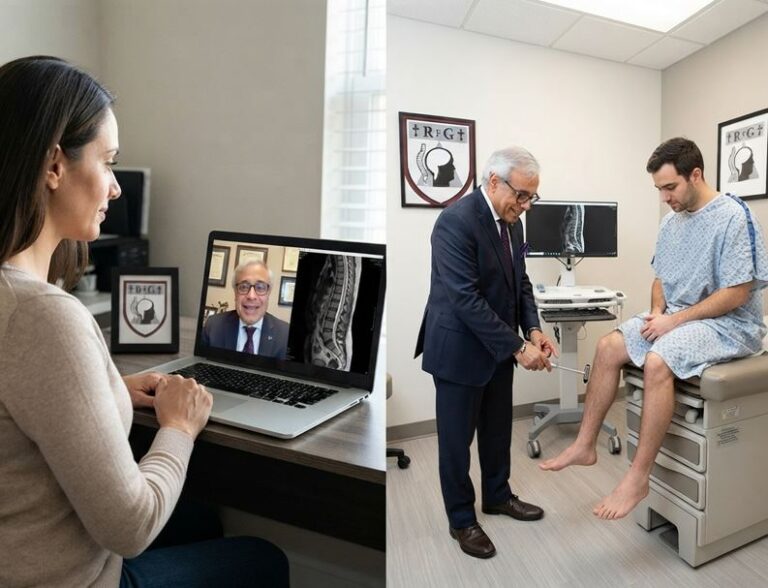
Dr. Ghaly’s office offers virtual consultations for brain conditions (tumors, aneurysm monitoring, post-craniotomy recovery), spine conditions (herniated discs, spinal stenosis, post-fusion follow-up), and peripheral nerve concerns including carpal tunnel syndrome. The team will help you determine the right format when you call.
Related reading: Telehealth services · Spinal surgery · Brain surgery · Carpal tunnel surgery
When telehealth is not the right choice
Some symptoms need emergency care, not a virtual visit. Call 911 or go to the nearest emergency room for:
- Sudden, severe headache unlike any you’ve had
- Sudden weakness, numbness, facial droop, or trouble speaking
- New loss of bladder or bowel control, or numbness in the groin or saddle area
- Seizure, fainting, or a sudden change in consciousness
- Rapidly worsening weakness in an arm or leg
For new or fast-changing symptoms that are not an emergency, an in-person evaluation is generally the more accurate starting point. Call the office and the team will help you choose.
How telehealth works with Dr. Ghaly
- Fill out the contact form. Share your information and reason for the visit via the contact page.
- Brief phone call. The office reaches out to understand your needs and confirm telehealth is a good fit.
- Schedule your visit. Options include video consultation, phone visit, or secure image review.
- Attend your visit. Join from a computer, tablet, or smartphone.
- Leave with a plan. Next steps may include a treatment plan, an imaging referral, or an in-person evaluation.
What to have ready:
- Your MRI or CT scans (or send them ahead of time)
- A list of current medications
- Prior records related to your condition
- A short list of your questions
Not sure whether you need a live visit or a document review? See Second Opinion vs. Medical Records Review.
Ready to start? Book your telehealth appointment or call 630-978-6143.
Questions to ask your insurer before a telehealth visit
Because “7-day rule” language varies by payer, a short call can save you surprises:
- Is a video visit with a neurosurgeon covered, and what is my copay or coinsurance?
- Are phone-only or portal-message visits covered?
- Does my plan limit telehealth to certain locations or provider types?
- If I’m in a post-surgery follow-up period, are virtual follow-ups bundled into the surgery cost?
- Do I need a referral for a specialist telehealth visit?
For billing and insurance questions, the practice lists HealthPCP at 708-532-6029.
Telehealth, second opinion, or records review?
- Telehealth consultation: A live visit to discuss symptoms, imaging, and options, or to follow up after treatment.
- Medical second opinion: An independent evaluation if you’ve been told you need surgery and want confirmation first. See How to Get a Second Opinion on Surgery.
- Medical records review: A detailed review of your scans and history, without needing to travel first.
Wondering whether back or neck pain needs an operation at all? Read When Is Spine Surgery Necessary?
FAQs
What is the 7-day rule for telehealth?
It isn’t one rule. It usually refers to a billing rule for brief virtual check-ins (7 days before, 24 hours after), a 7-day window for e-visits, or a 7-day supply limit in some telehealth prescribing situations.
Is there a limit on how often I can use telehealth?
There is no universal weekly limit. Your insurance plan may have its own rules, so confirm coverage before booking.
Can I have a telehealth visit and an in-person visit within 7 days?
Yes, you can receive care in both formats. The 7-day language mainly affects how a brief virtual check-in is billed when it is connected to a related visit. Ask billing how your plan handles it.
What is the 24-hour part of the telehealth rule?
It applies to brief virtual check-ins. If one leads to a related visit within 24 hours or the soonest available appointment, it is generally not billed as a separate service.
Does Medicare cover telehealth in 2026?
Yes. Medicare telehealth flexibilities were extended through December 31, 2027, but they are temporary. Confirm your specific coverage with Medicare or your plan.
Is there a 7-day rule for prescribing medication by telehealth?
Some rules for controlled substances reference a 7-day supply in limited circumstances. Requirements depend on the drug, your state, and the prescriber.
Can I do a post-surgery follow-up by telehealth?
Often, yes. Many follow-up visits can be done virtually so your surgeon can monitor recovery and adjust your plan. See the telehealth page.
Is a virtual neurosurgeon visit as accurate as an in-person visit?
It works well for reviewing history, imaging, and follow-up care. New or rapidly changing symptoms are best evaluated in person.
What do I need for a telehealth appointment?
A computer, tablet, or smartphone with internet access. Have your imaging and records ready or sent ahead.
Can I see a neurosurgeon online if I don’t live near Aurora, IL?
Dr. Ghaly’s practice offers telehealth to patients outside the Aurora and Naperville area, including outside Illinois. The office will confirm what applies to your situation.
Talk to a board certified neurosurgeon, from home or in Aurora
Dr. Ramsis F. Ghaly is a board certified neurosurgeon with decades of experience treating brain, spine, and peripheral nerve conditions. He serves patients in Aurora, Naperville, and the greater Chicago area in person, and patients across the country by telehealth.
- Request a telehealth appointment
- Call: 630-978-6143 or 630-578-7500 (new patients and urgent messages press 0)
- Office: Ghaly Neurosurgical Associates, Fox Valley Office Commons, 4260 Westbrook Dr., Suite 127, Aurora, IL 60504
- Hours: Mon–Fri, 9:00 AM–5:00 PM