
What Happens During a Medical Records Review?
You may have been told you need brain or spine surgery. Or you may be holding a stack of MRI reports from three different providers, or hearing two different recommendations for the same problem. Somewhere along the way, someone suggested a medical records review.
It’s a fair question to ask what that actually involves before you hand over your records. This guide walks through the full process, from your first request to the moment you understand what your records show.
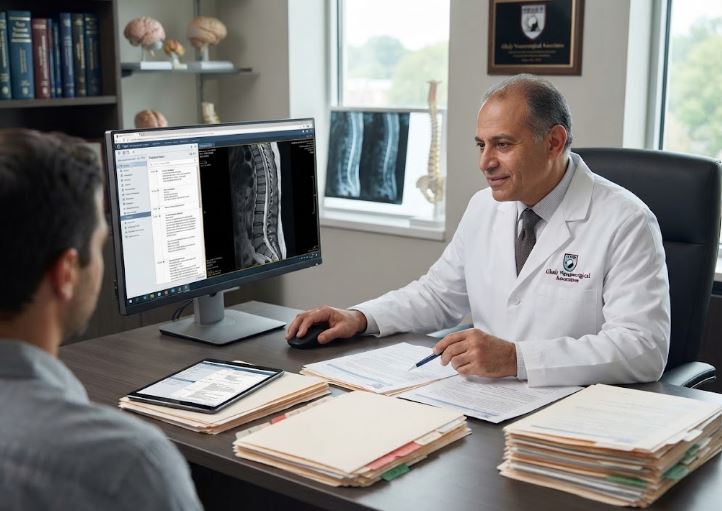
In a neurosurgical medical records review, your records and imaging are collected from every provider you’ve seen. They are organized into one chronological history and checked for missing reports or scans. A neurosurgeon then revie ws the whole picture in clinical context. You come away understanding what your records show, what has already been tried, what may be missing, and what to ask or do next. At Ghaly Neurosurgical Associates, Dr. Ramsis Ghaly personally reviews each case, and the entire process can be done remotely.
A note on scope: “Medical records review” also describes insurance audits, legal chart reviews for attorneys, and hospital quality reviews. This guide covers the patient-requested version, where a specialist reviews your records to help you understand your condition and options.
Already have your records and want a neurosurgeon’s perspective? Request your medical records review →
What Is a Medical Records Review?
A medical records review is a structured evaluation of your medical history, imaging, physician notes, test results, operative reports and prior treatments, brought together and reviewed by a specialist as a single picture.
This matters because a single MRI report or office visit rarely tells the whole story. Context such as how your condition has progressed, what has already been tried, and what different doctors concluded can change how a diagnosis or surgical recommendation looks.
The Medical Records Review Process at a Glance
| Stage | What happens | What you do |
|---|---|---|
| 1. Request | You tell the office about your condition and what you want reviewed | Fill out the contact form or call |
| 2. Submit | The office gives instructions for sending records, scans and reports | Gather and send your materials |
| 3. Organize | Records from different providers are sorted into one organized file | Nothing |
| 4. Clinical review | Dr. Ghaly reviews your history, imaging and prior treatments in context | Nothing |
| 5. Timeline, summary and gaps | Your history is built into a chronology and summary, and missing records are flagged | Supply anything flagged as missing |
| 6. Review with Dr. Ghaly | You hear his neurosurgical perspective and can raise your treatment questions | Bring your questions |
The sections below explain each stage.
Step 1: You Request a Review and Describe Your Situation
You start with a short contact form or a phone call. The more clearly you describe what you need, the more useful the review will be. Helpful details include:
- The diagnosis you were given, if any
- Any surgery or procedure that has been recommended
- Your main symptoms and roughly when they started
- Which providers you’ve seen
- The one question you most want answered (for example, “Is this surgery really necessary?”)
You don’t need a referral, and you don’t need to have everything organized yet. Organizing it is part of the service.
Step 2: You Send Your Records and Imaging
After your request, the office gives you instructions for submitting your materials securely. Typical items include:
- MRI and CT scans, ideally the actual images and not only the reports
- Radiology reports for each study
- Physician and specialist notes
- Operative reports from any prior surgery
- Diagnostic test results, such as nerve conduction studies for hand or arm symptoms
- Records of past treatments, such as medications, physical therapy and injections
- Any written surgical recommendation you’ve received
Why the images matter: A radiology report is one radiologist’s reading of a scan at one moment. A neurosurgeon reviewing the scan itself can examine the anatomy directly and compare it with your symptoms. Imaging centers can usually provide images on a disc or through a secure download link, often in a format called DICOM. Don’t worry if you only have the reports at first, because the office can tell you what to request next. For a fuller checklist, see what records to bring to a spine consultation.
Not sure what to send? Start your request and our office will walk you through it. Call 630-978-6143 (new patients, press 0) or request a review online →
Step 3: Your Records Are Organized Into One File
Records from different hospitals, imaging centers and physicians rarely arrive in a logical order. In this step they are sorted by provider and date so they can be read as one story. Duplicates are separated out, and differences between providers’ notes become easier to see.
Many patients tell us this step alone is clarifying. For the first time, everything is in one place.
Step 4: A Neurosurgeon Reviews the Full Picture
This is the core of the review. Dr. Ghaly examines your history, imaging and prior treatments together, rather than handing them to a third-party records-processing company. A neurosurgical review is designed to answer questions like these:
- Do your symptoms and your imaging tell the same story? Scan findings don’t always match symptoms. Many people have findings that cause no trouble, and some have significant symptoms with modest findings.
- How have your findings changed across studies over time?
- What treatments have been tried, and how did you respond?
- What has each provider recommended, and is the reasoning documented?
- Is there anything that needs prompt attention?
Step 5: Your Timeline, Summary and Missing-Records Check
Next, the information is built into a chronological timeline and a clinical summary. A missing-records check flags anything that appears to be absent, such as a report that never arrived, a prior scan needed for comparison, or an operative note.
Finding a gap early is a real benefit. It tells you exactly what to request before any big decision.
Step 6: You Review the Findings With Dr. Ghaly
Finally, Dr. Ghaly shares his neurosurgical perspective so you can understand your case and raise your treatment questions. The office will confirm how and when this takes place for your situation.
What you walk away with:
| What you receive | Why it helps |
|---|---|
| A chronological timeline | Shows how your condition has progressed |
| A clinical summary | Puts your history and findings in plain terms |
| Organized records from all providers | One file you can share with future doctors |
| A missing-records list | Tells you what to request before deciding |
| A neurosurgeon’s perspective | Context for your diagnosis, imaging and options |
| Questions for your treating doctor | Makes your next appointment more productive |
What Happens After the Review?
The review is a starting point for your decision. Depending on what it shows, your next step might be:
- Moving forward with more confidence because your current plan appears well supported and you understand the reasoning.
- Collecting missing information before any decision is made.
- Requesting a neurosurgical second opinion, in person at the Aurora office or by secure video, if a question about surgery remains. A records review tells you what your case shows. A second opinion tells you what to do about it. Our guide to second opinion vs. medical records review explains how they fit together.
- Asking your current surgeon better questions, including about nonsurgical options.
If you’re weighing surgery, these background guides may help: when spine surgery is necessary and when brain tumor surgery is necessary.
What a Records Review Does Not Do
A good review is honest about its limits:
- It is not emergency care. See the red flags below.
- It is not a physical exam. Some questions can’t be answered from paper and scans alone. If so, the sensible next step may be an in-person or telehealth visit, or additional testing.
- It doesn’t guarantee an outcome or promise that a recommended surgery will change.
- It is not an insurance or legal review.
Seek Emergency Care First If You Have:
- A sudden, severe headache unlike any you’ve had
- Sudden weakness, trouble speaking, facial droop, vision loss or confusion
- New loss of bladder or bowel control
- Numbness in the groin or saddle area
- Rapidly worsening weakness in an arm or leg
- A significant injury or trauma
Call 911 or go to the nearest emergency room. Don’t wait for a records review.
How to Get Your Own Medical Records
Many patients don’t realize they have a legal right to their records. Under HIPAA, you can request copies of your medical records from most healthcare providers. A few practical points:
- Start with the patient portal. Many providers let you view and download records and reports right away.
- Otherwise, make a written request. Providers generally must respond within 30 days, with one possible 30-day extension if they notify you in writing. Some state laws set shorter deadlines.
- Fees must be reasonable. Providers may charge only limited, cost-based fees for copies.
- Ask for electronic copies of both reports and imaging.
- Request imaging separately. Scans are usually held by the imaging center or hospital radiology department, not the doctor’s office.
The U.S. Department of Health and Human Services explains this right in its HIPAA right of access guidance.
Who Benefits Most From a Medical Records Review?
A review can be especially useful if you:
- Have been told you may need spine or brain surgery
- Have a complex or long-running history across multiple providers
- Received different recommendations from different doctors
- Want your MRI or CT findings understood in the context of your full history
- Have carpal tunnel, ulnar nerve or other peripheral nerve concerns
- Feel overwhelmed by your records and aren’t sure what’s missing
Dr. Ghaly reviews records primarily for brain, spine and peripheral nerve conditions.
Ready for clarity before a major decision? Request a medical records review →
Do I Need to Travel to Aurora, IL?
No. The review is available online to patients across the United States and internationally. Patients in Aurora, Naperville and the greater Chicago area are welcome to visit our Fox Valley office, but it isn’t required. If a follow-up visit makes sense, you can choose between in-person and telehealth. Our guide to telehealth vs. in-person neurosurgeon consultations can help you decide.
Cost, Insurance and Privacy
A medical records review with Dr. Ghaly is an out-of-pocket service and isn’t billed through insurance. This allows the review to proceed without insurance restrictions or time limits. Contact the office for current fees and timing.
Your records are sensitive health information. Before sending anything, use the submission instructions the office gives you, and avoid sending scans or reports by unsecured email.
Questions to Ask After Your Review
- What do my records and imaging show, and how do they fit my symptoms?
- Is the recommended treatment well supported by the findings?
- What nonsurgical options should I consider first, if any?
- Is any information still missing?
- What are the realistic risks, benefits and timeline?
- Do I need an in-person exam or further testing before deciding?
Why Patients Choose Dr. Ghaly
Dr. Ramsis F. Ghaly is a board-certified neurosurgeon, a Diplomate of the American Board of Neurological Surgeons, and a clinical professor with decades of experience treating the brain, spine and peripheral nerves. Your case is personally reviewed by Dr. Ghaly. His approach is to give patients a clear, honest understanding of their condition before recommending a path forward, and to recommend surgery only when it’s the right choice. Learn more about Dr. Ghaly →
FAQs
How long does a medical records review take?
Timing depends mostly on how quickly your complete records and imaging arrive and how much material there is. Missing items can add time, which is why the office flags gaps early. Contact the office for current timing.
Does the neurosurgeon look at my actual scans or just the report?
A review includes MRI and CT scans along with their reports. Sending the images is strongly recommended because a report reflects one radiologist’s reading, while the scans let the neurosurgeon look at your anatomy directly.
Is a medical records review the same as a second opinion?
No. A records review gathers, organizes and evaluates the information you already have. A second opinion is a fresh clinical recommendation, often built on that reviewed information. Many patients start with a review and move to a second opinion afterward.
Do I need to be in Illinois?
No. Patients throughout the U.S. and internationally can use the service entirely online.
Will insurance cover it?
No. It’s an out-of-pocket service. Contact the office for current fees.
What if some of my records are missing?
Identifying missing records is part of the review. You’ll learn which reports, scans or notes to request so your case can be evaluated completely.
Can a records review tell me whether I need surgery?
It can help you understand whether a recommendation is well supported and what to ask next. If a physical exam or further testing is needed, that becomes the next step.
What conditions can be reviewed?
Primarily brain, spine and peripheral nerve conditions, including brain tumors, herniated discs, spinal stenosis, carpal tunnel syndrome and ulnar nerve conditions.
What if my surgery feels urgent?
For emergency symptoms, go to the nearest emergency room. For non-emergency recommendations, ask your surgeon how time-sensitive the decision is. A review can often be done before you commit.
Is my information kept private?
Your records are protected health information and are handled confidentially. Follow the office’s submission instructions and avoid unsecured email.
Take the Next Step
You don’t have to make sense of your records alone. Whether you need your history organized, a neurosurgeon’s perspective, or help deciding what to do next, Dr. Ghaly will personally review your case.
Request Your Medical Records Review Online →
Or call 630-978-6143 or 630-578-7500 (new patients, press 0).
Ghaly Neurosurgical Associates
4260 Westbrook Dr., Suite 127, Aurora, IL 60504
Mon–Fri 9:00 AM–5:00 PM · Weekends by request
This article is for educational purposes and isn’t a substitute for personal medical advice. If you have new, worsening or emergency symptoms, seek in-person care immediately.