
When Is Brain Tumor Surgery Necessary? A Neurosurgeon’s Guide to the Decision
Hearing the words “brain tumor” changes everything in a moment. The next question is almost always the same: Do I need surgery?
Brain tumor surgery is generally recommended when a tumor is causing or likely to cause neurological problems, is growing, needs to be sampled for a diagnosis, is raising pressure inside the skull, or can be removed with acceptable risk. It is not needed for every tumor. Small, slow-growing tumors that cause no symptoms are often monitored with repeat MRI scans instead.
This guide explains how that decision is made, which situations usually point toward surgery, and which point away from it. It also covers what to do if you have been told you need an operation, or that your tumor is “inoperable.”
Key takeaways
- Surgery is common for symptomatic, growing or unclear tumors, but it is not automatic.
- The decision depends on tumor type and grade, size, location, symptoms, your overall health and your goals.
- Observation, radiation, radiosurgery, medication and chemotherapy are all part of the conversation.
- You have every right to a second opinion before a major brain operation.
Worried about a diagnosis or a scan? Request an appointment with Dr. Ghaly or call the Aurora office at 630-978-6143.
What “Necessary” Means in Brain Tumor Care
A brain tumor is an abnormal growth of cells in or around the brain. It may be primary (starting in the brain or its coverings) or metastatic (spreading from cancer elsewhere in the body). The skull is a closed space, so even a non-cancerous tumor can cause problems by pressing on healthy brain tissue.
Surgery can serve several goals:
- Removal: taking out the whole tumor when that can be done safely.
- Maximal safe resection: taking out as much tumor as possible without causing new deficits.
- Diagnosis: obtaining tissue (a biopsy or resection) so pathology can confirm the tumor type and grade.
- Relief of pressure: reducing compression, swelling or blocked spinal fluid flow.
- Access for other treatments: improving how well radiation or drug therapy can work.
“Necessary” therefore rarely means one thing. It depends on which of these goals matter most in your case.
8 Situations Where Brain Tumor Surgery Is Commonly Recommended
1. The tumor is causing symptoms
New or worsening headaches, seizures, weakness, numbness, speech trouble, vision changes, balance problems or personality and memory changes can all come from a tumor pressing on brain tissue. When symptoms are tied to the tumor, surgery is often considered to relieve the pressure.
2. The tumor is growing
A tumor that gets larger on serial MRI scans, even slowly, may need treatment before it causes deficits or becomes harder to remove.
3. A diagnosis is needed
MRI is very good at showing where a mass is, but it cannot always say exactly what it is. A tissue sample gives the tumor type and grade, and in many cases molecular results. Those findings guide decisions about radiation, chemotherapy and follow-up.
4. Pressure or fluid buildup is dangerous
Significant swelling, midline shift or blocked cerebrospinal fluid flow (hydrocephalus) can be urgent. Treatment may involve surgery to remove a tumor, relieve pressure or restore fluid flow.
5. The tumor is benign and accessible
Some non-cancerous tumors, such as many meningiomas, can be cured or well controlled with surgery when they sit in a reachable location and are causing or threatening problems.
6. The tumor is a malignant primary tumor
For many gliomas, surgery is the first step. The aim is to confirm the diagnosis and remove as much tumor as can be done safely, and then radiation and drug therapy are planned around what pathology shows.
7. A metastatic tumor is symptomatic or accessible
Brain metastases are handled differently from primary tumors. Surgery may be considered for a single or limited number of tumors that are causing symptoms or are in a removable location, especially when your overall cancer status and functional health allow it. These decisions are usually made together with your oncology team, and radiosurgery is often part of the discussion.
8. Tumor-related seizures are not controlled by medication
When seizures keep happening despite appropriate medication, removing the tumor may help, depending on where it is.
When Surgery Is Often Not the First Step
Observation (“watch and wait”) can be entirely appropriate when:
- The tumor was found incidentally and you have no symptoms.
- The tumor appears benign and slow-growing, such as a small meningioma.
- The risks of an operation outweigh the likely benefit, for example when a tumor sits deep or beside critical structures, or you have other serious health conditions.
- Another treatment, such as radiosurgery, can control the tumor with less risk.
A typical monitoring plan involves repeat MRI (often at a first short interval and then on a regular schedule) plus clear instructions about symptoms that should prompt earlier review.
Tumor Types and How Decisions Often Differ
This table is a general overview. Individual recommendations vary with imaging, pathology and your health.
| Tumor type | Common approaches | Where surgery usually fits |
| Meningioma (often grade 1) | Observation, surgery, radiation or radiosurgery | Symptomatic, growing, or accessible tumors |
| Glioma (low- or high-grade) | Surgery, radiation, chemotherapy | Often the first step for diagnosis and maximal safe removal |
| Brain metastasis | Surgery, radiosurgery, radiation, systemic therapy | Symptomatic or accessible tumors, coordinated with oncology |
| Pituitary adenoma | Medication, surgery, radiation | Depends on hormone type, size and vision effects |
| Vestibular schwannoma (acoustic neuroma) | Observation, radiosurgery, surgery | Growing or symptomatic tumors |
What Your Neurosurgeon Weighs Before Recommending Surgery
- Tumor type and grade (WHO grades run from 1, slow-growing, to 4, aggressive)
- Size, growth rate and effect on surrounding brain
- Location, especially near areas that control speech, movement or vision
- Symptoms and how quickly they are changing
- Your age, other medical conditions and overall functional status
- Prior treatments and your personal goals
Surgeons match technique to the tumor. Dr. Ghaly’s practice describes using tools such as exoscope-assisted visualization, microsurgery, minimally invasive and endoscopic approaches for select tumors, and stereotactic, image-guided targeting. Which approach fits depends on your anatomy and diagnosis. Not every tumor is suited to every technique.
Risks to Weigh (Both Ways)
Any brain operation carries risks, including bleeding, infection, swelling, seizures and new neurological changes. The tumor’s location and your health influence those risks. The comparison that matters is between the risks of surgery and the risks of leaving the tumor untreated. A good consultation lays out both in plain language.
Warning Signs That Deserve Prompt Evaluation
See a doctor promptly for:
- New or worsening headaches that feel different from your usual pattern
- A first-time seizure
- Weakness, numbness or trouble speaking
- Vision changes, double vision or blurred vision
- Loss of balance or coordination
- Progressive confusion, memory change or personality change
These symptoms do not always mean a tumor, but they warrant an exam and usually brain imaging.
Call 911 or go to the nearest emergency room for the worst headache of your life, sudden weakness or loss of speech, loss of consciousness, a new seizure or sudden vision loss.
“I Was Told My Tumor Is Inoperable.” Now What?
Sometimes “inoperable” means a specific surgeon judged the risk too high. Sometimes it reflects the techniques available at one center. A neurosurgical second opinion can confirm the recommendation or identify options worth exploring, such as different surgical approaches, radiosurgery or a referral to a specialized team.
Questions to Ask Before Agreeing to Surgery
- What type of tumor do you think this is, and how sure are you?
- What is the goal of surgery: complete removal, partial removal, biopsy or pressure relief?
- What happens if we wait or monitor instead?
- What are the specific risks for a tumor in this location?
- Would radiosurgery, radiation or medication be a reasonable alternative or addition?
- How many operations like mine do you perform?
- What will recovery look like, and what follow-up imaging will I need?
- Would you support a second opinion?
Have an MRI report and a surgery recommendation? Send your imaging for a medical records review or book a neurosurgical second opinion before you decide.
How to Prepare for Your Consultation
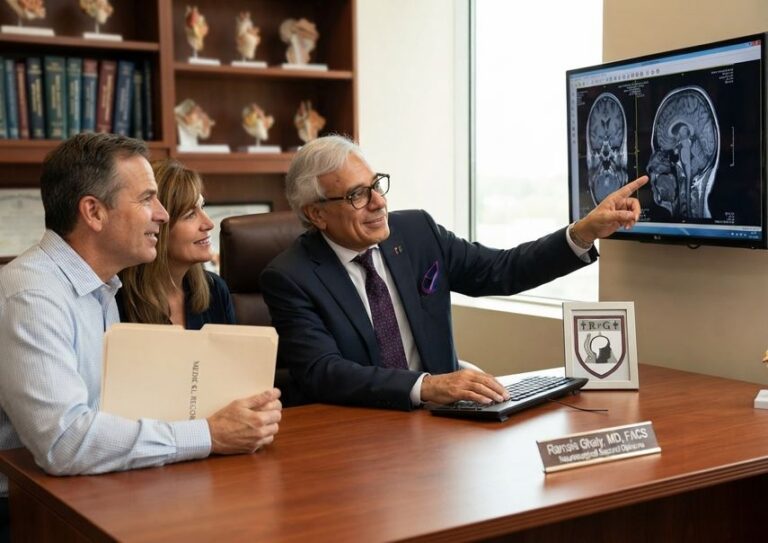
Gather your MRI or CT images (the actual scans, not only the reports), a list of current medications, and a short timeline of your symptoms. Note any previous treatments and the questions above. The more complete your records, the more useful the evaluation.
Brain Tumor Evaluation With Dr. Ramsis Ghaly in Aurora, IL
Dr. Ghaly is a board-certified neurosurgeon and clinical professor. His practice describes an approach built on personally reviewing your imaging and history, explaining surgical and nonsurgical options, and recommending surgery only when it is the right choice for you. Learn more about brain surgery and brain tumor care or read about Dr. Ghaly’s background.
Options include:
- In-person consultation at the Aurora office, for patients from Aurora, Naperville and the greater Chicago area
- Telehealth consultation for patients elsewhere in Illinois, across the U.S. or abroad
- Second opinion, in person or virtual, for anyone who has already been given a recommendation
Insurance note: according to the practice, in-person second opinions are typically billed through insurance like a standard visit, while virtual second opinions are generally out of pocket. Call the office to confirm coverage for your plan.
Ghaly Neurosurgical Associates
Fox Valley Office Commons, 4260 Westbrook Dr., Suite 127, Aurora, IL 60504 (near Fox Valley Mall)
Phone: 630-978-6143 or 630-578-7500
Hours: Mon–Fri, 9:00 AM–5:00 PM; weekend appointments by request
FAQs
Do all brain tumors need surgery?
No. Small, slow-growing tumors without symptoms, particularly some meningiomas, are often monitored with periodic MRI. Surgery is more likely when a tumor is growing, causing symptoms, raising pressure, needing a tissue diagnosis, or removable with acceptable risk.
Can a benign brain tumor be left alone?
Sometimes. “Benign” describes how the cells behave, not whether the tumor is harmless. A benign tumor in a sensitive location can still cause serious symptoms, so location and growth matter as much as the label.
How do I know if I need brain tumor surgery?
A neurosurgeon reviews your MRI, symptoms, neurological exam and health history. Growth on imaging, tumor-related symptoms, pressure effects and the need for a diagnosis are the most common reasons surgery is recommended.
How urgent is surgery after a brain tumor diagnosis?
It varies. Tumors causing swelling, midline shift or blocked fluid flow can need prompt treatment. Others allow time for further testing, a second opinion and careful planning.
What if the tumor cannot be completely removed?
Partial removal can still relieve pressure, provide a diagnosis and improve how well radiation or drug therapy works. The goal is usually maximal safe resection, meaning as much as can be removed without causing new neurological problems.
Is surgery possible for tumors near speech or movement areas?
Often, with careful planning. Surgeons use imaging guidance and other tools to protect critical areas, and sometimes a less aggressive removal is chosen to preserve function. Ask your surgeon how they would handle your tumor’s specific location.
What happens if I delay or decline surgery?
It depends on the tumor. For a small, stable, symptom-free tumor, monitoring may be reasonable. For a symptomatic or fast-growing tumor, delay may allow progression and limit options. Ask your surgeon to explain what to expect in your case.
Can I get a second opinion before brain tumor surgery?
Yes. A second opinion can confirm the diagnosis and plan, or present alternatives. Dr. Ghaly offers second opinions in person or through secure video, and no referral is required.
Do I need a referral to see Dr. Ghaly?
Many patients schedule directly. Contact the office to confirm what applies to your situation.
How long is recovery after brain tumor surgery?
Recovery depends on the tumor, its location, the type of operation and your health. Your surgeon should explain expected hospital time, activity limits and follow-up imaging before surgery.
This article is for general education and is not medical advice. Diagnosis and treatment decisions require an evaluation by a qualified physician. If you have symptoms of a medical emergency, call 911.