Should I Get a Second Opinion Before Brain Surgery?
In almost every non-emergency situation, yes you should get a second opinion before brain surgery. Brain surgery is rarely reversible, the diagnosis and treatment planning can be genuinely complex, and a second, independent review from a board-certified neurosurgeon either confirms you’re on the right path or uncovers something worth knowing before you commit. The only real exception is a true neurosurgical emergency, where waiting for a second opinion could cost you time you don’t have.
The rest of this guide walks through exactly when a second opinion matters most, when it’s reasonable to skip it, what it costs, how insurance and Medicare handle it, and how to actually get one including virtual options if you can’t easily travel.
Why This Decision Feels So Overwhelming
Hearing “you need brain surgery” is one of the most disorienting sentences a person can hear from a doctor. In the span of one appointment, you’re asked to absorb a diagnosis, understand imaging you were never trained to read, and make a decision that affects your brain, the one organ where “we’ll just fix it later” isn’t really an option.
It’s normal to walk out of that appointment with more questions than answers. Wanting a second, independent set of eyes on your case before you sign a surgical consent form isn’t second-guessing your doctor. It’s simply making sure every reasonable option has actually been considered.
When a Second Opinion Is Strongly Recommended
Major patient advocacy organizations focused on brain conditions including groups that work directly with academic neurosurgery centers actively encourage patients to seek a second opinion before non-emergency brain surgery whenever there’s time to do it. That guidance holds especially true if any of the following apply to you:
- You’ve been told you need surgery and want more confidence before moving forward. A second opinion either confirms the plan or opens up a conversation you didn’t know you needed to have.
- You feel rushed or pressured into a fast decision, and no one has clearly explained why it needs to happen immediately.
- You haven’t been offered non-surgical alternatives medication, monitoring, or a less invasive approach and you’re not sure whether they were ever considered.
- You were told your tumor or condition is “inoperable” or that there are “no other options.” These labels deserve a specialist’s second look, because interpretation of imaging and surgical risk can vary meaningfully between surgeons.
- Your case is complex or rare: an unusual tumor type or location, a difficult-to-access aneurysm, or a condition your current doctor doesn’t frequently treat.
- You want to understand risk before an irreversible procedure, such as a craniotomy, tumor resection, or aneurysm clipping.
- Your insurance requires a specific in-network provider, but you’d like an independent expert’s evaluation before you commit to that surgeon’s plan.
When It’s Reasonable to Move Forward Without One
A second opinion isn’t always necessary, and waiting isn’t always safe. Seek immediate emergency care not a second opinion if you’re experiencing:
- The worst headache of your life, arriving suddenly
- Sudden weakness, numbness, or loss of coordination
- Loss of consciousness or a new seizure with no prior history
- Signs of an actively bleeding aneurysm or rapidly worsening neurological symptoms
In these scenarios, minutes matter, and your care team’s job is to stabilize you first. Once you’re stable, however, it’s still reasonable to ask about a second opinion for any decisions that follow, such as a second surgical stage or ongoing treatment planning.
Decision Framework at a Glance
| Situation | Is a Second Opinion Recommended? |
| Elective or scheduled surgery for a tumor, aneurysm, or spinal-related brain condition | Yes strongly recommended, if time allows |
| You were told the condition is “inoperable” or there are “no options” | Yes get a specialist review before accepting this as final |
| You feel rushed, unclear on risks, or unsure why surgery is urgent | Yes clarity now prevents regret later |
| True neurosurgical emergency (active bleed, sudden severe symptoms) | No treat first; ask questions once stable |
| You’ve already seen two specialists who independently agree, and you feel fully informed | Optional your comfort level is the deciding factor |
Will Asking for a Second Opinion Upset My Surgeon?
This is one of the most common hesitations patients have and it shouldn’t be. A confident, experienced neurosurgeon does not take offense when a patient wants another qualified opinion before an irreversible procedure. If a doctor reacts defensively to a reasonable request like this, that reaction alone is worth paying attention to. Reputable surgeons understand that brain surgery decisions belong to the patient, not the surgeon, and that patients who feel informed tend to do better both practically and emotionally through surgery and recovery.
You are not required to justify the request, and you don’t need a referral from your current physician to seek one elsewhere.
Does Insurance Cover a Second Opinion Before Brain Surgery?
In most cases, yes, with some nuance:
- Original Medicare (Part B) generally covers a second opinion before non-emergency surgery, and even covers a third opinion if the first two disagree. You typically pay 20% coinsurance after your deductible, and no referral is required.
- Medicare Advantage plans generally offer similar coverage, though you’ll want to confirm the second doctor is in-network for your specific plan.
- Most private insurance plans cover second opinions for serious diagnoses or major surgery when it’s considered medically necessary but confirm this with your carrier, since coverage and referral requirements vary by plan.
- In-person second opinions are typically billed through insurance the same way a standard specialist visit would be.
- Virtual (telehealth) second opinions are frequently treated as an out-of-pocket expense rather than a billed insurance visit; this is worth confirming before you book, since it affects your cost expectations.
If your insurance mandates a specific in-network surgeon, you still have the right to seek an independent opinion. Many plans offer out-of-network benefits even when a preferred provider exists, and a virtual, out-of-pocket second opinion remains an option regardless of network restrictions.
Not sure if your case qualifies as urgent, elective, or something in between? Request a second opinion consultation with Dr. Ghaly, and his office can help you understand your timeline before you decide anything.
What a Second Opinion Can Actually Change
A second opinion doesn’t automatically mean a different outcome but it gives you one of two valuable results:
- Confirmation. The second surgeon agrees with the original diagnosis and plan. This doesn’t waste your time; it replaces uncertainty with confidence going into surgery.
- New information. The second surgeon identifies a different surgical approach, a non-surgical alternative worth trying first, additional imaging worth obtaining, or in some cases determines that immediate surgery isn’t actually necessary.
Either outcome is useful. The goal isn’t to “win” a disagreement between doctors; it’s to make sure your decision is based on the fullest possible picture of your case before you commit to something as significant as brain surgery.
Red Flags Worth a Second Look
Consider a second opinion more urgent if your current experience includes any of these:
- Your provider hasn’t personally reviewed your actual imaging only a written report or summary
- You’ve received conflicting information from different members of your care team
- Your questions about risks, alternatives, or recovery were answered vaguely or not at all
- You were told the surgery is “urgent” but no one has explained what happens if you wait a short time to get a second opinion
- Your case involves a rare tumor type, an unusual location, or a condition your current surgeon doesn’t treat frequently
None of these automatically mean something is wrong with your current plan but they’re exactly the situations where an independent review of your diagnosis, imaging, and treatment plan tends to bring the most value.
Questions to Ask During Your Second Opinion Consultation
Bring these to your appointment in person or virtual so you leave with real answers, not just reassurance:
- Why is surgery being recommended, and what happens if I wait or choose a non-surgical option?
- What are the specific risks and potential complications for a procedure like mine?
- Is there a less invasive or minimally invasive approach available for my condition?
- How many similar procedures have you personally performed?
- What does recovery typically look like, and how long before I return to normal activity?
- Does my case require immediate action, or is there time to gather more information?
- If you disagree with my current treatment plan, what would you recommend instead and why?
How to Get a Second Opinion In Person or Virtually
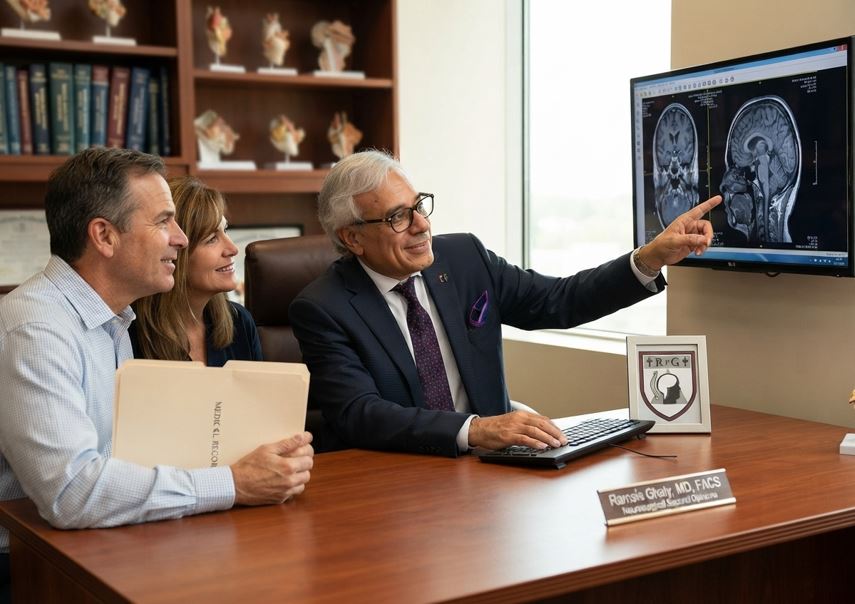
You don’t need to live near Aurora, Illinois to get an independent review of a brain surgery recommendation. Dr. Ramsis Ghaly, a board-certified neurosurgeon with over 40 years of surgical experience and affiliations with Cook County Health and Advocate Illinois Masonic Medical Center, personally reviews every case himself, imaging included rather than delegating it to a resident or third-party reviewer.
Getting started typically looks like this:
- Reach out, call the office or start the process through the contact page.
- Share your records securely and send your MRI, CT scans, or other imaging along with your current treatment recommendation. If your records are scattered across multiple providers, a medical records review can help organize everything into one clear clinical picture first.
- Case review Dr. Ghaly reviews your imaging and history before your visit, not just a summary of it.
- Consultation meet in person at the Aurora office, or virtually through a secure telehealth visit if travel isn’t practical.
- Your recommendation leaves with a clear, honest assessment of your diagnosis and options, so your next step is your decision, made with confidence.
Dr. Ghaly provides second opinions across the full range of brain conditions, including brain tumors, aneurysms, hemorrhage, Chiari malformation, traumatic brain injury, and craniotomy recommendations as well as spine and peripheral nerve conditions when those are also part of your case.
You don’t have to make this decision alone or on someone else’s timeline. Request a second opinion with Dr. Ghaly in person in Aurora, IL, or virtually from anywhere in the country.
Frequently Asked Questions
Is it normal to get a second opinion before brain surgery?
Yes. It’s a common and widely encouraged step for any non-emergency brain surgery recommendation. Patient advocacy organizations focused on brain conditions actively recommend it whenever there’s time before the procedure.
Will getting a second opinion delay my treatment?
Usually only briefly, and only for non-emergency cases. Most second opinion consultations can be scheduled promptly once your records and imaging are submitted, and true emergencies are managed immediately regardless of a pending second opinion.
Do I need a referral to get a second opinion?
No referral is required to request a second opinion from Dr. Ghaly. Bringing your existing imaging and records simply helps make the consultation more thorough.
How much does a second opinion for brain surgery cost?
It depends on your insurance and whether the visit is in-person or virtual. In-person second opinions are typically billed like a standard specialist visit, while virtual second opinions are often an out-of-pocket expense. Contact the office directly to confirm costs for your specific situation.
Can a second opinion tell me I don’t actually need surgery?
Yes this happens. A second opinion sometimes identifies a non-surgical alternative or determines that immediate surgery isn’t necessary, particularly when the original recommendation was made quickly or without a full review of imaging and history.
What if my insurance requires me to use a specific surgeon?
You still have the right to seek an independent opinion. Many plans offer out-of-network benefits even with a required in-network provider, and a virtual second opinion remains available as an out-of-pocket option regardless of network restrictions.
Can I get a virtual second opinion if I can’t travel to Illinois?
Yes. Telehealth second opinions allow Dr. Ghaly to review your imaging and history and discuss your case over secure video, for patients anywhere in the U.S. or internationally. Cases requiring a hands-on physical exam may still need an in-person visit.
You do not have to navigate a brain surgery decision alone. Request an online appointment or call 630-978-6143 to start your second opinion with Dr. Ghaly.