What Records Should You Bring to a Spine Consultation?
The most useful things to bring to a spine consultation are your MRI, CT, or X-ray images (not just the reports), records from earlier treatment, a current medication list, and a short written timeline of your symptoms. With those in hand, a neurosurgeon can see what is happening in your spine, understand what has already been tried, and spend your appointment on answers instead of guesswork.
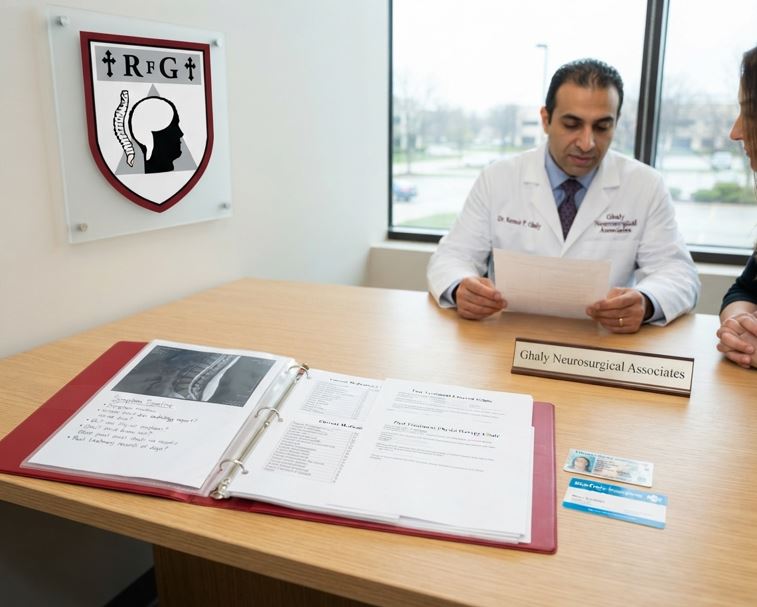
Bring these five things
- Your imaging: the actual MRI, CT, or X-ray images, plus the radiology reports
- Records from previous care: doctor notes, physical therapy, injections, and any prior spine surgery
- A current list of medications, supplements, and allergies
- A symptom timeline and the questions you want answered
- Your photo ID, insurance card, and completed patient forms
Missing something? Call our office before your visit, and we’ll tell you which items matter most for your situation.
You don’t need a perfect binder. You do need enough information for the specialist to connect three things: what you feel, what the exam shows, and what your imaging shows. This guide explains what to bring, why each item matters, and how to get anything you don’t have yet.
Not sure what you have? Call Ghaly Neurosurgical Associates in Aurora, IL at 630-978-6143 (press 0 if you’re a new patient), or request an appointment online.
Spine Consultation Records Checklist
| What to bring | Why it matters | Where to get it |
| MRI, CT, and X-ray images (disc or portal link) | Lets the neurosurgeon see your anatomy directly instead of relying on a summary | The imaging center or hospital radiology department |
| Radiology reports | The radiologist’s written findings, useful alongside the images | Same source; often in your patient portal |
| Notes from previous doctors | Shows earlier diagnoses, exam findings, and referrals | Primary care, orthopedic, neurology, pain management offices |
| Treatment history (physical therapy, chiropractic, injections, medications tried) | Shows what has been tried and how you responded | Provider offices, plus your own notes |
| Prior spine surgery records | Clarifies your current anatomy and any hardware | The hospital medical records department or your prior surgeon |
| Other test results (nerve studies, bone density, relevant lab work) | Fills in nerve function, bone health, and overall health | The ordering provider or lab portal |
| Medication and allergy list | Supports safe treatment planning | Your pharmacy printout or your own list |
| Symptom timeline and questions | Only you can provide this, and it guides the exam | You (template below) |
| Photo ID, insurance card, referral if your plan requires one, completed forms | Registration and billing | Our patient forms |
Imaging: Bring the Images, Not Only the Report
For most spine problems, imaging is the most important item on this list. Dr. Ghaly personally reviews your history and your available MRI, CT, and X-ray imaging as part of a spine surgery evaluation.
Which scans to bring
- MRI: shows discs, nerves, the spinal cord, and other soft tissue. It is often the key study for herniated discs and spinal stenosis.
- CT scan: shows bone detail well.
- X-rays: show alignment and bone structure. Studies taken standing, or bending forward and backward, can show how the vertebrae move, which matters when instability such as spondylolisthesis is a concern.
Bring every study related to your spine, including older ones. Comparing scans over time can show whether a finding is new, stable, or changing.
Why the report alone isn’t enough
A radiology report is a written summary from the radiologist who read your scan. The images are the scan itself. Reports are valuable, but a neurosurgeon reviewing the images directly can judge things a summary can’t: how much a disc is pressing on a nerve, how narrow the spinal canal actually is, and whether what’s on the scan matches where you feel symptoms.
That last point matters more than most patients expect. Disc bulges and age-related changes appear on MRI in many people who have no back pain at all. The goal isn’t to treat a scary phrase in a report. It’s to find the finding that explains your symptoms.
Disc, USB, or online portal?
Bring the disc or original films if you have them. If your images live in an online portal, ask the imaging center for a shareable link or a downloadable copy of the full study (some portals show only the report). To send images before your visit, ask our office how to do it securely rather than attaching them to a regular email.
How recent should your imaging be?
Practices set different cutoffs, and there’s no single rule. Newer imaging better reflects your current symptoms, while older scans still help with comparison. If your symptoms have changed since your last scan, such as new numbness, weakness, or trouble walking, tell us when you call. Updated imaging may be part of the plan.
Can’t get to Aurora right away? You can send your imaging and records for a neurosurgical medical records review before deciding on next steps. Dr. Ghaly reviews the case himself, and the review can flag missing records. It is an out-of-pocket service, and you can request it here.
Medical Records That Give Your Spine Care Context
Notes from previous providers
Include records from any doctor who has evaluated your neck or back problem: primary care, orthopedics, neurology, pain management, chiropractic, or physical therapy. Diagnoses, exam findings, and referral letters help a specialist avoid repeating tests and see how your condition has progressed.
Your treatment history
“I’ve tried everything” isn’t specific enough to plan from. Write down or bring documentation of:
- Physical therapy: when you went, for how long, and what changed
- Injections: the type (for example, an epidural steroid injection), the date, the spinal level or area treated, and how much relief you got and for how long
- Medications tried: what you took, at what dose, and whether it helped
- Other treatments: chiropractic care, heat or ice, activity changes, bracing
Prior spine surgery
If you’ve had spine surgery, bring the operative report, the discharge summary, and any implant information you were given, along with post-surgery imaging.
Other tests and general health records
Bring results from nerve studies (such as EMG or nerve conduction testing), bone density testing, and relevant lab work if you’ve had them. Records for other conditions matter too. Heart disease, lung disease, diabetes, and blood-thinning medications can all affect which treatments are safe for you.
Your Medication, Allergy, and Health History List
Bring a written list of:
- Prescription medications, with dose and how often you take them
- Over-the-counter pain relievers, such as acetaminophen, ibuprofen, or naproxen
- Muscle relaxants, sleep aids, and supplements
- Blood thinners and aspirin (especially important to mention)
- Allergies, including reactions to medications or contrast dye
- Past surgeries and significant medical conditions
Your Symptom Timeline: The Record Only You Can Write
A short timeline often helps more than a stack of paper. Jot down answers to these before your visit:
- When did it start, and was there an injury or event?
- Where is the pain? Does it stay in your neck or back, or travel into a shoulder, arm, buttock, or leg?
- Do you have numbness, tingling, or weakness? Where, and is it constant or intermittent?
- What makes it better or worse? Sitting, standing, walking, bending, coughing, lying down?
- How does it affect daily life? How far can you walk? How long can you sit? Is sleep disrupted?
- Has anything changed recently, such as getting worse, spreading, or new symptoms?
Be specific and honest. Downplaying symptoms, even out of habit, can lead to an incomplete picture.
Paperwork and Logistics
- Photo ID and insurance card. Our insurance department, HealthPCP, can verify coverage at 708-532-6029.
- Referral, if your plan requires one. Many patients schedule directly without a referral, but requirements vary, so confirm with our office.
- Patient forms. Download the full patient forms package or the Health Assessment Form. If you’d like us to request records from another provider, ask whether you should complete the Release of Confidential Health Information form.
- Arrive early. If possible, arrive about 30 minutes before your first appointment to finish forms.
- Consider bringing a support person. A family member or friend can help you remember what was discussed and ask questions you may forget.
Special Situations
If you’ve been told you need spine surgery
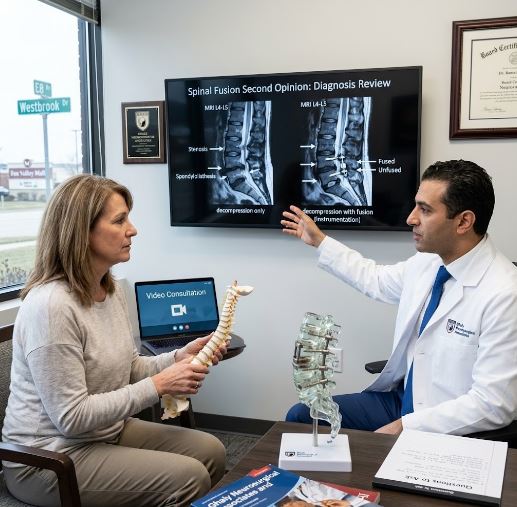
Bring everything above, plus the recommendation itself: the name of the proposed procedure (for example, spinal fusion, lumbar disc surgery, or cervical laminectomy), the spinal level involved, the recommending surgeon’s notes, and the imaging that surgeon reviewed. Then write down your questions about why surgery was recommended and what the alternatives are.
A neurosurgical second opinion doesn’t mean you distrust your doctor. It means you’ve confirmed that the diagnosis fits and every reasonable option has been considered. Facing a surgery decision? Request a second opinion appointment before you commit.
If you’re outside the Aurora area or can’t travel
Dr. Ghaly offers telehealth consultations for spine conditions, including patients outside Illinois. The process starts with the contact form, followed by a brief phone call from our office, and then scheduling. Having your imaging and records available or sent ahead makes the visit more productive. Some conditions, particularly new or rapidly changing symptoms, are best evaluated with an in-person exam, and our team will help you choose the right format. Virtual second opinions are out-of-pocket services.
If your symptoms are related to a work injury or car accident
Mention it when you call. Our downloadable patient forms include a separate registration form for applicable cases, and it helps to have the date of injury and any claim details handy.
How to Get Your Records (If You Don’t Have Them Yet)
- Start with the imaging facility. Ask for the images and the radiology report. Facilities often provide a disc or a portal link, sometimes very quickly.
- Request notes from each provider. Use the patient portal if there is one, or contact the office or hospital records department.
- Know your rights. Under HIPAA, you have a right to your health records. Providers generally must act on a request within 30 days, with one possible extension of up to 30 more days if they explain the delay in writing. You can usually choose the format, such as electronic copies. You can also ask a provider to send your records directly to another provider, typically with a signed written request. See the HHS overview of your right of access.
- Don’t wait until everything is collected. Tell our office what is still on the way when you request your appointment, and we’ll advise on whether to wait or proceed.
What If I Can’t Get Everything?
Missing records are common, and they don’t have to stall your care. Call us, explain what you have and what you can’t get, and we’ll help you sort out what matters most. Sometimes the next step is simply identifying the gaps, which is one thing a medical records review is designed to do. Sometimes it’s a recommendation for updated imaging.
5 Common Mistakes When Preparing for a Spine Consultation
- Bringing only the written report. Bring the images too.
- Leaving older scans at home. They help show change over time.
- Not documenting injections and therapy. “I had a shot once” isn’t enough. Type, date, and location help.
- Skipping the medication list. Blood thinners, supplements, and over-the-counter pain relievers all matter.
- Waiting until everything is perfect before calling. Start the conversation early and let the office guide you.
Questions Worth Writing Down
- What do you think is causing my symptoms, and do my images support that?
- What nonsurgical options make sense for me?
- If surgery is an option, which procedure, at which level, and why?
- What are the risks, the expected recovery, and the likely outcome?
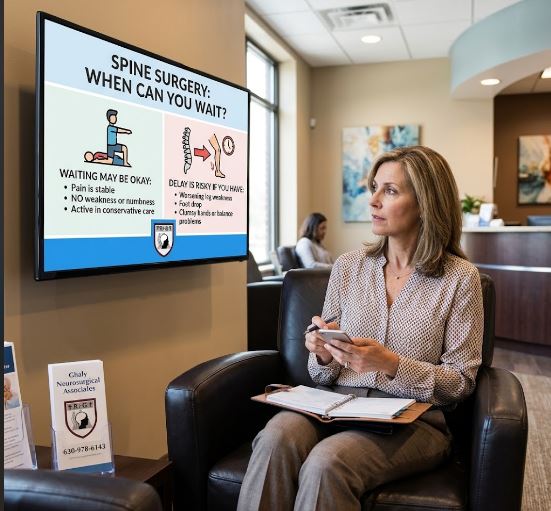
- What happens if I wait?
- Which symptoms should make me call you sooner?
What Happens After You Bring Your Records
Dr. Ghaly reviews your symptoms, medical history, physical and neurological findings, and your imaging. He then walks through both surgical and nonsurgical options, including whether more testing is needed. Many spine conditions are first managed with physical therapy, medication, activity changes, or injections, and surgery is recommended only when it’s the right choice for you. You can read more about how we approach spine surgery evaluation in Aurora and about Dr. Ghaly’s background.
Don’t wait for a routine appointment if you have emergency symptoms. New loss of bladder or bowel control, numbness in the groin or saddle area, severe or rapidly worsening weakness, or other sudden neurological changes can signal a medical emergency, including serious nerve compression such as cauda equina syndrome. Seek emergency medical care right away.
Schedule Your Spine Consultation in Aurora, IL, or Online
Dr. Ramsis F. Ghaly is a board-certified neurosurgeon who sees patients in Aurora, Naperville, and the greater Chicago area, and offers telehealth consultations, second opinions, and records review to patients nationwide.
Ghaly Neurosurgical Associates
Fox Valley Office Commons, 4260 Westbrook Dr., Suite 127, Aurora, IL 60504 (close to the Fox Valley Mall)
Phone: 630-978-6143 or 630-578-7500 (press 0 for new patients)
Hours: Monday to Friday, 9:00 AM to 5:00 PM; weekends by request
Request Your Spine Consultation →
Frequently Asked Questions
What should I bring to my first spine consultation?
Bring your spine imaging (images and reports), records from previous doctors and treatments, a medication and allergy list, a symptom timeline, and your photo ID, insurance card, and completed forms. Bring any CDs or original films you have. If possible, arrive about 30 minutes early to finish paperwork.
Do I need to bring my MRI to see a spine specialist?
Yes, if you have one. Your MRI helps the neurosurgeon connect your symptoms to what’s happening in your spine. If you don’t have imaging yet, call before your visit so the office can advise you on next steps.
Is the MRI report enough, or do I need the actual images?
Bring both. The report is a radiologist’s written summary, while the images let your surgeon see your anatomy directly and compare it with your symptoms and exam.
What if I don’t have my MRI or medical records yet?
Call our office, tell us what you have and what’s missing, and we’ll help you prioritize. A records review can identify gaps, and in some cases updated imaging may be recommended.
How recent does my spine imaging need to be?
There’s no single rule, and practices differ. Recent imaging best reflects your current symptoms, while older scans help show change over time. Bring both, and tell us if your symptoms have changed since your last scan.
Do I need a referral to see a neurosurgeon for my spine?
Many patients schedule directly without a referral, but requirements can vary by insurance plan and situation. Contact our office to confirm what applies to you. No referral is required to request a second opinion.
What records do I need for a spine surgery second opinion?
Bring the written surgical recommendation (procedure and level), the recommending surgeon’s notes, all imaging and reports, and your treatment history, including physical therapy and injections. Our second opinion service walks you through the process.
Can I have a telehealth spine consultation or send records ahead of time?
Yes. Start with the contact form, and our office will call to confirm the right format. Sending imaging and records ahead helps the visit run more smoothly. Some cases need an in-person exam, and virtual second opinions and records reviews are out-of-pocket services. Learn more about telehealth consultations.
How long does it take to get my records from another provider?
Under HIPAA, providers generally must act on your request within 30 days, with one possible 30-day extension when they give written notice. Many respond faster, especially through patient portals, so request records early.
Will I need surgery after my first spine consultation?
Not necessarily. Many spine conditions are first managed with nonsurgical care such as physical therapy, medication, activity changes, or injections. A consultation is about understanding your diagnosis and your options so you can decide what’s right for you.
This article is for general education and is not a substitute for personal medical advice, diagnosis, or treatment.