Second Opinion Before Spinal Fusion: How to Know If Fusion Is Really Necessary
If a surgeon has told you that you need spinal fusion, you are probably holding two feelings at once: relief that there is a plan, and a nagging question about whether it is the right one. Both are reasonable. Fusion is permanent, and few decisions in spine care depend so heavily on the details of your diagnosis.
Quick answer: Should you get a second opinion before spinal fusion?
In almost every non-emergency case, yes. Fusion permanently joins vertebrae, and how well it works depends on why it is being recommended. An independent neurosurgeon can review your actual imaging and history, confirm the diagnosis, check that your scan explains your symptoms, and tell you whether a smaller operation or nonsurgical care deserves a fair try first. Sudden bladder or bowel changes, numbness in the saddle area, or rapidly worsening weakness are emergencies. Do not wait for an opinion if you have them.
If you want an independent review now, you can request a spinal fusion second opinion with Dr. Ghaly in Aurora, IL, or by secure video from anywhere. You can also call 630-978-6143.
What Is Spinal Fusion?
Spinal fusion is surgery that permanently joins two or more vertebrae so they heal into a single solid segment. The surgeon places bone graft material along or between the vertebrae. It is often supported by screws, rods, or a cage while the graft heals. The goal is to eliminate painful or harmful movement at that level and protect the nerves.
Fusion is not one operation. It can be done in the neck (cervical) or lower back (lumbar). It can be approached from the back, front, or side, and it can involve one level or several. The terms on a surgical plan can hide important decisions, so here is a quick decoder:
| Term on your plan | What it usually means |
|---|---|
| ACDF | Anterior cervical discectomy and fusion: a disc in the neck is removed through the front and the vertebrae are fused |
| PLIF / TLIF / ALIF | Posterior, transforaminal, or anterior lumbar interbody fusion: different routes to place a cage and graft between lower-back vertebrae |
| Instrumentation | Metal hardware (screws, rods, plates, cages). It almost always means a fusion is part of the plan |
| Level(s) | The vertebral segments involved. L4–L5 is one level; L4–S1 is two |
| Decompression / laminectomy | Removing bone or tissue to relieve pressure on nerves. This alone does not fuse the spine |
| Pseudarthrosis | A fusion that fails to fully knit together |
Spinal fusion is not automatically the answer to neck or back pain. Many conditions start with nonsurgical care such as physical therapy, medication, activity changes, or injections, and surgery is considered when those fail or when there is progressive neurological compromise. For a broader look at timing, see our guide to when spine surgery is necessary.
Why Does Spinal Fusion Deserve a Second Opinion?
Three things set fusion apart from smaller spine procedures.
It cannot be undone. Once vertebrae fuse, that segment no longer moves. The levels above and below absorb more of the daily load, which is why the reason for fusing needs to be solid.
The evidence depends on your diagnosis. Fusion has a strong track record for some problems and a much weaker one for others. A 2017 systematic review in Neurosurgery pooled comparative studies of lumbar fusion for degenerative conditions. It found the greatest clinical improvement in people fused for spondylolisthesis (a vertebra slipping forward over the one below). For spinal stenosis, complications and reoperations limited the benefit. Complications were about 1.9 times more frequent after fusion than after decompression alone. The authors also noted that, because the evidence is uncertain, fusion rates for degenerative conditions vary more between surgeons and regions than for any other operation they measured.
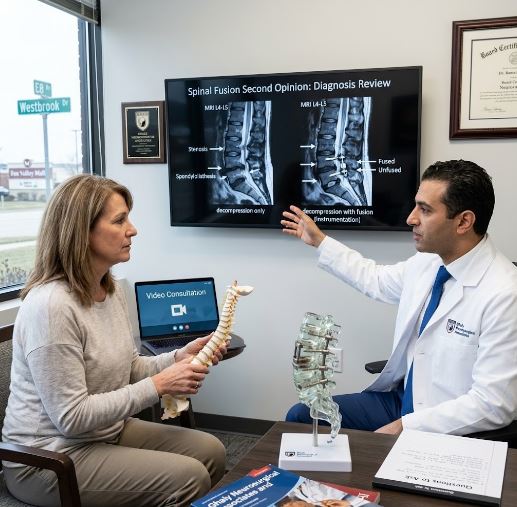
The word “fusion” is often tacked onto another operation. A plan for “decompression” and a plan for “decompression with fusion” are answering different questions. Whether the fusion part is truly needed is one of the most common reasons two surgeons disagree in good faith.
When Is Spinal Fusion Well Supported, and When Does It Deserve Scrutiny?
This table gives you a reference point. It is not a verdict on your case, which depends on your imaging, exam, and history.
| Situation | Where fusion fits | What a second opinion should confirm |
|---|---|---|
| Spondylolisthesis (slippage) with instability or nerve compression | Among the better-supported uses of fusion | Is the slip real and symptomatic? Does it move on flexion-extension X-rays? Would decompression alone be enough? |
| Fracture, tumor, infection, or trauma that destabilizes the spine | Fusion is often needed to stabilize | Urgency, and how many levels truly need support |
| Spinal deformity (scoliosis, kyphosis) that is progressing or causing neurological symptoms | Fusion is often part of correction | Curve progression, symptoms, number of levels, overall spinal balance |
| Cervical disc or stenosis compressing a nerve root or the spinal cord | Fusion (ACDF) is commonly performed after the disc or bone is removed | Does the compression match your symptoms? Is fusion, decompression, or a motion-preserving option the best fit? |
| Lumbar stenosis without slippage | Decompression is the core operation; adding fusion has been linked to more complications and reoperations in pooled data | Why is fusion being added? Is there instability, or would decompression leave the segment unstable? |
| Back pain from degenerative disc disease without instability or nerve compression | The most debated use; UK guidance (NICE NG59) advises against offering fusion for low back pain outside of research | What specific problem will fusion fix? Has a structured course of nonsurgical care been tried? |
| Recurrent herniation or a prior surgery | Case by case | Why the earlier surgery fell short, and whether the expected benefit justifies a larger operation |
Signs Your Fusion Recommendation Deserves a Second Opinion
A second opinion is reasonable for anyone facing elective fusion. It is especially worth doing if:
- Fusion was recommended mainly for back pain without leg or arm symptoms
- The plan involves multiple levels, and you don’t know why each one is included
- The recommendation came at your first visit, before nonsurgical treatment was tried or documented
- Your surgeon cannot point to the structure on your scan that explains your main symptom
- Your imaging and symptoms don’t seem to match, for example several worn levels but pain in one spot
- You are facing revision surgery on a spine that was already operated on
- You feel rushed or pressured, or you have been told you have “no other options”
- You can’t explain in your own words what will be removed, what will be joined, and which symptom should improve
If any of these sound familiar, book a spinal fusion second opinion. The review itself is where clarity starts.
What Does Research Say About Second Opinions Before Spine Surgery?
The best-known study is a 2017 prospective observational study in BMC Musculoskeletal Disorders (Lenza et al.). Of 544 patients referred, 485 patients who had been recommended spinal surgery took part. Each received a second assessment from a physiatrist and an orthopaedic surgeon, and cases needing surgery review went to a panel of senior spine surgeons.
Among the 425 who completed the full process:
- Only about one in three (33.6%) were recommended surgery at the end
- The same specific surgical recommendation as the first surgeon came back in just 15.5%
- 55.3% were advised to try conservative treatment instead
- 11.1% were not considered to have a spinal condition
Diagnoses agreed in only about half of cases (53%).
These numbers are striking, but they have limits. The study was observational and done in Brazil, with patients referred by their insurers. The second-opinion physicians were hospital employees who may lean toward conservative care. The authors also stress that they cannot say which opinion was “more correct.” In the subset who went on to treatment at that hospital, surgical and conservative groups improved similarly at 12 months.
What the research does support is modest but important. When surgery is recommended, an independent review often changes the diagnosis, the procedure, or the decision to operate at all, and that is worth knowing before an incision. It does not show that fusion is overused everywhere or that any particular surgeon is wrong.
What Should a Second Opinion Before Spinal Fusion Actually Cover?
A useful review does more than say yes or no. It tests the plan. Dr. Ghaly personally reviews your imaging and history as part of every second opinion rather than delegating the review, and the evaluation typically works through these questions:
- Is the diagnosis right? Are the labels on your MRI report the real source of your pain?
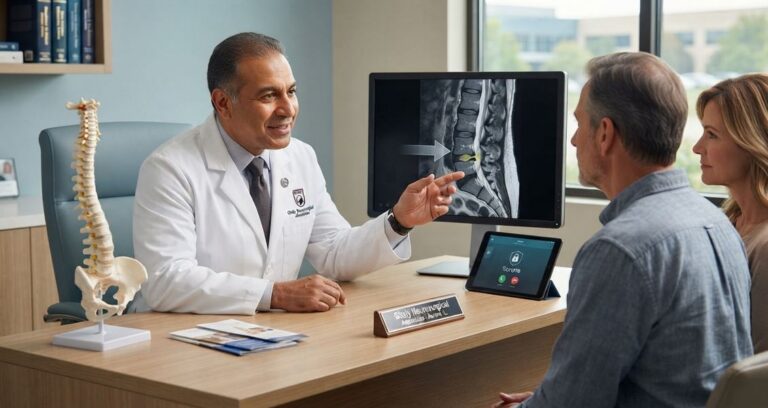
- Does the scan match the story? MRI shows structure, not pain. Disc bulges and arthritis appear on the scans of many people with no symptoms, so a compressed nerve on the image should line up with your symptom pattern and your exam.
- Is there true instability? If slippage or abnormal motion is the reason for fusion, flexion-extension X-rays and your imaging should show it.
- Has nonsurgical care been adequate? What was tried, for how long, and was it appropriate to your condition?
- Is fusion needed, or would decompression alone work? This is the most common point of legitimate disagreement.
- Are the levels and technique right? Which levels, from which approach, with what hardware, and why?
- Are you a good surgical candidate? Bone health, smoking, diabetes, and other conditions can affect healing and risk.
Because Dr. Ghaly also performs spinal fusion, a second opinion with him is not a search for a “no.” It is an independent read of whether fusion fits your anatomy and symptoms. Sometimes it confirms the plan, and sometimes it points to a smaller operation or nonsurgical care. Either way, you leave with reasoning you can understand. Read more about Dr. Ramsis Ghaly’s background and approach or the full range of spinal surgeries he performs.
What Are the Alternatives to Spinal Fusion?
The right alternative depends on the diagnosis, and a good second opinion should name yours. Options to ask about include:
- Nonsurgical care: physical therapy, medication, activity modification, and injections
- Decompression alone (such as a laminectomy), when the problem is pinched nerves rather than an unstable segment
- Microdiscectomy, which removes only the herniated portion of a disc
- Minimally invasive techniques, when your condition and anatomy allow them
- Fusing fewer levels, since longer fusions can place more stress on neighboring segments
- Motion-preserving disc replacement in carefully selected cervical cases, though long-term data are still accumulating
Alternatives aren’t always better. Fusion is the right operation for some problems, and a second opinion that confirms it can be just as valuable.
What Risks Should You Weigh Before Spinal Fusion?
Every surgery carries general risks such as infection, bleeding, blood clots, and anesthesia complications. Fusion has a few of its own:
- Pseudarthrosis (nonunion): the graft doesn’t fully unite, which can cause ongoing pain or require another operation. Smoking, diabetes, and poor bone health are commonly cited factors that make healing harder.
- Adjacent segment disease: because a fused level no longer moves, neighboring levels take on more stress and can wear faster. Estimates vary widely. One retrospective series of 1,069 lumbar fusions found about 2.6% needed a second operation for adjacent-level problems. Imaging changes next to a fusion don’t by themselves mean another operation is needed.
- Hardware problems: screws or rods can loosen or, rarely, break
- Persistent symptoms: fusion treats a specific problem. It does not guarantee relief of every pain, especially when the cause of the pain is unclear
The goal isn’t to frighten you. It is to make sure the expected benefit outweighs these risks for your specific diagnosis.
What Should You Bring or Send for a Spinal Fusion Second Opinion?
The more complete your records, the more useful the review. Gather:
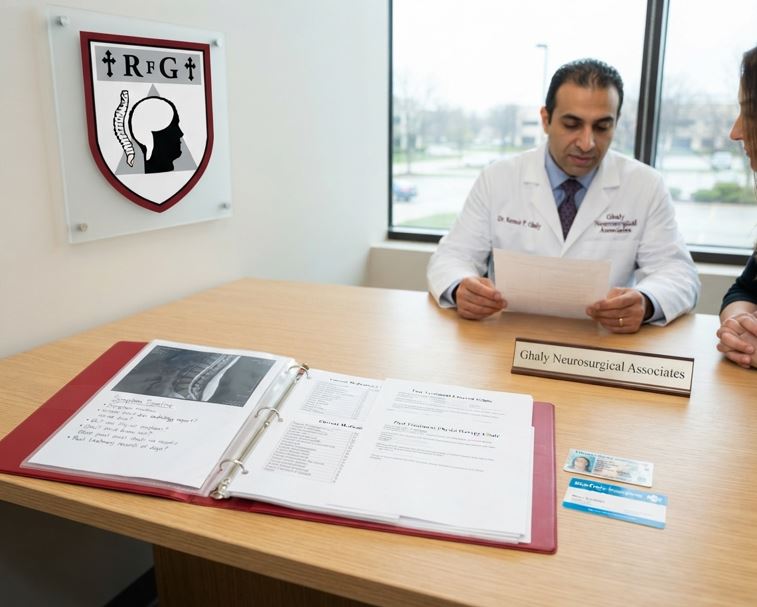
- The actual MRI and CT images (on disc or via a download link), not just the written reports
- X-rays, especially flexion-extension (bending) X-rays if they were done
- The first surgeon’s notes and written surgical recommendation
- A treatment history with dates: physical therapy, medications, injections, and how each worked
- Operative reports from any prior spine surgery
- A current medication list
- A one-page symptom timeline: when it started, where it travels, what makes it better or worse, and what you can no longer do
Our guides on what records to bring to a spine consultation and the online neurosurgery consultation records checklist walk through each item. Not sure whether you need a full opinion or a records review first? Compare second opinion vs. medical records review.
Ready to send your records? Start your request here and the office will explain how to submit imaging securely.
How Does a Second Opinion With Dr. Ghaly Work?
- Reach out. Use the contact form or call the office.
- Share your records. Send MRI, CT, X-rays, notes, and the surgical recommendation you received.
- Personal case review. Dr. Ghaly reviews your imaging and history before your visit.
- Consultation. Meet in person in Aurora, IL, or by secure video.
- Your recommendation. Receive a clear assessment of your diagnosis and options, including surgical and nonsurgical paths.
You can choose the format that fits:
| Format | Best for | Notes |
|---|---|---|
| In-person second opinion (Aurora, IL) | A full evaluation with a physical exam and direct imaging review | Typically billed through insurance like a standard visit; coverage depends on your plan |
| Virtual second opinion (telehealth) | Patients outside Chicagoland or who can’t travel | Out-of-pocket, not billed through insurance. Some cases still need an in-person exam |
| Medical records review | Organizing records from several providers and getting specialist context | Out-of-pocket; available nationwide and internationally |
For help choosing, see telehealth vs. in-person neurosurgeon consultations.
Does insurance cover a second opinion? In general, Original Medicare Part B covers a second opinion before medically necessary, non-emergency surgery. If the first two opinions disagree, it also covers a third. You typically owe the usual 20% coinsurance after your deductible, and the doctor must accept Medicare. Medicare Advantage plans must offer at least the same coverage, though some HMO plans require a referral. Private plans vary. Please call the office to confirm what applies to you.
What If the Second Opinion Is Different From the First?
Disagreement is common and useful. First, find exactly where the two opinions differ:
- Reading the imaging: one surgeon sees compression where the other sees normal aging
- Symptom match: both agree on the anatomy but not whether it explains your pain
- Timing: surgery now vs. more time with rehabilitation
- The operation itself: most often decompression alone vs. decompression with fusion, or one fusion technique vs. another
Take the second opinion back to your first surgeon and ask them to respond to the specific point of difference. A third opinion is reasonable if the two still conflict. When two experienced surgeons land in different places, it usually means the decision is a genuine judgment call, and your priorities (recovery time, tolerance for hardware, and risk) belong in the choice. See how to get a second opinion on surgery and whether a second opinion can confirm your diagnosis.
When Should You Not Wait for a Second Opinion?
Seek emergency medical care right away, rather than waiting for a routine consultation, if you have:
- New loss of bladder or bowel control
- Numbness in the groin, buttocks, or inner thighs (the “saddle” area)
- Severe or rapidly progressing weakness
- Weakness or sciatica in both legs
- Other sudden neurological changes
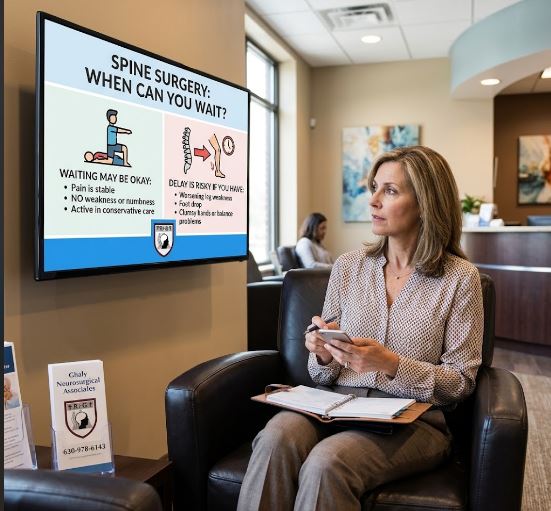
These can signal compression that needs urgent treatment. For stable pain without these features, gathering records and getting another opinion over a few weeks is usually reasonable, but report any change to your treating clinician promptly.
Questions to Ask Before Agreeing to Spinal Fusion
Bring these to both appointments and write down the answers:
- Which structure on my scan is causing my main symptom? Can you show me?
- Why fusion instead of decompression alone?
- Is there instability, and how was it measured?
- Which levels are included, and why each one?
- What approach and hardware will you use?
- Which symptoms are likely to improve, and which may not?
- What nonsurgical options haven’t been tried yet?
- What happens if I wait three months?
- What are the most likely complications for me, given my health?
- What would you do if the surgery doesn’t relieve my symptoms?
Clear, anatomical, plain-language answers suggest a well-reasoned plan. Vague ones show where a second opinion should focus.
Frequently Asked Questions
Should I get a second opinion before spinal fusion?
For any planned, non-emergency fusion, yes. Fusion is permanent, and its benefit depends on the diagnosis. A second opinion confirms the reason for fusing, checks whether your scan matches your symptoms, and lays out alternatives. Emergencies such as cauda equina syndrome shouldn’t be delayed.
How do I know if I really need spinal fusion?
Fusion is best supported for instability (such as spondylolisthesis), certain fractures, deformity, and some neck or back conditions where nerve compression is clearly responsible for your symptoms. It is less certain for back pain alone without instability or nerve compression. A neurosurgeon reviewing your imaging, exam, and treatment history can tell you which category you are in.
What are the alternatives to spinal fusion?
Depending on your diagnosis: physical therapy, medication, activity changes, injections, decompression alone, microdiscectomy, fusing fewer levels, minimally invasive techniques where appropriate, and in selected neck cases, motion-preserving disc replacement. Your surgeon should explain why an alternative does or doesn’t fit.
Will asking for a second opinion offend my surgeon?
It shouldn’t. Second opinions before major elective surgery are routine, and most offices send records on request. A thoughtful surgeon welcomes an independent review, particularly when more than one reasonable approach exists.
Does insurance or Medicare cover a second opinion before spinal fusion?
Original Medicare Part B generally covers a second opinion before medically necessary, non-emergency surgery, and a third if the first two disagree. Private insurance varies. At Ghaly Neurosurgical Associates, in-person second opinions are typically billed through insurance, while virtual second opinions and records reviews are out-of-pocket. Call the office to confirm your coverage.
Can I get a spinal fusion second opinion online?
Yes. Dr. Ghaly offers virtual second opinions by secure video for patients anywhere in the U.S. and internationally. He reviews your imaging and records and discusses your case in detail. If your situation needs a hands-on exam, an in-person visit may be recommended.
What records do I need for a spinal fusion second opinion?
The actual MRI and CT images (not just reports), X-rays including flexion-extension views if available, the first surgeon’s notes and recommendation, your treatment history with dates, any prior operative reports, a medication list, and a short symptom timeline.
Is it safe to wait for a second opinion?
For stable pain without red-flag symptoms, a few weeks is generally reasonable, and nonsurgical care is often the first step anyway. If you develop bladder or bowel changes, saddle numbness, or rapidly worsening weakness, seek emergency care immediately.
Should a neurosurgeon or an orthopedic surgeon give the second opinion?
Both neurosurgeons and orthopedic surgeons with spine training perform fusion. What matters is experience with your specific condition, a direct review of your actual images, and clear reasoning you can follow.
What if the second opinion disagrees with the first?
Identify exactly where they differ (diagnosis, timing, or the type of operation). Bring the second opinion back to your first surgeon, and consider a third opinion if they still conflict. The disagreement itself is useful: it shows the decision involves real judgment, where your priorities matter.
Get Clarity Before You Commit to Fusion
You don’t have to make this decision alone, or quickly. Dr. Ramsis Ghaly, a board certified neurosurgeon, reviews your imaging, records, and prior recommendation, then explains your surgical and nonsurgical options in plain language. Patients across Aurora, Naperville, and the Chicago area can visit the office, and patients nationwide can connect by secure video.
Request Your Spinal Fusion Second Opinion →
Ghaly Neurosurgical Associates
Fox Valley Office Commons, 4260 Westbrook Dr., Suite 127, Aurora, IL 60504 (near Fox Valley Mall)
Phone: 630-978-6143 or 630-578-7500. Press 0 if you are a new patient.
Hours: Monday–Friday, 9:00 AM–5:00 PM. Weekends by request.
This article is for general education and is not a substitute for medical advice, diagnosis, or treatment. Decisions about surgery should be made with a physician who has examined you and reviewed your imaging. If you have symptoms of a medical emergency, call 911 or go to the nearest emergency department.