
Second Opinion vs. Medical Records Review: Which One Do You Actually Need?
If you’ve just been told you need brain or spine surgery or you’re staring at a stack of MRI reports trying to make sense of what happens next you’ve probably come across two different terms: medical second opinion and medical records review. They sound similar. They’re often used interchangeably by patients. But they are not the same service, they don’t answer the same questions, and choosing the wrong one first can waste time you don’t have.
This guide breaks down exactly what each one is, how they differ, and most importantly which one fits where you are right now in your decision-making process.
Key Takeaway
A medical records review organizes and evaluates the information you already have. A second opinion goes a step further: it’s a fresh clinical diagnosis and treatment recommendation from an independent specialist. Many patients start with a records review and move into a second opinion once their case is fully organized.
What Is a Medical Records Review?
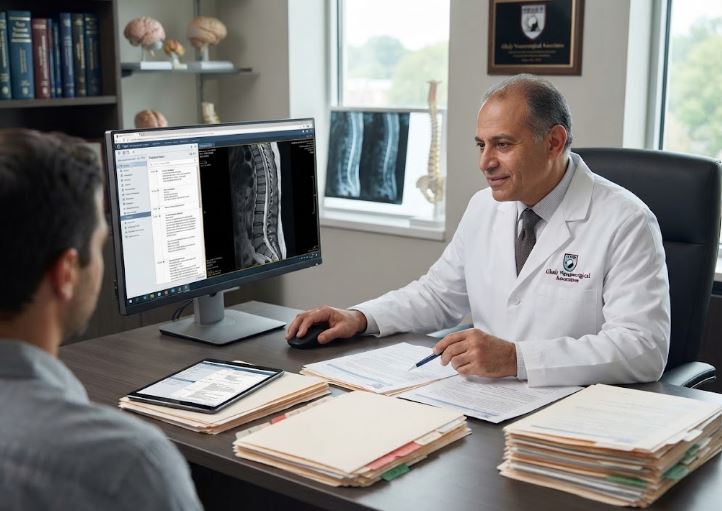
A medical records review is a structured evaluation of your existing medical history, your imaging (MRI, CT, X-ray), physician notes, operative reports, specialist consultations, and prior treatment records pulled together from every provider you’ve seen and reviewed by a specialist as a single, organized clinical picture.
It doesn’t necessarily involve a new physical exam or a formal diagnosis. Instead, it answers questions like:
- What does my complete medical history actually show?
- Are my records consistent across providers, or are there conflicting notes?
- Is anything missing a scan, a report, a consult that I need before moving forward?
- What has already been tried, and what hasn’t?
This is often the first step for patients who have seen multiple providers, have a complicated or years-long history, or simply feel like no one has looked at the “whole picture” at once.
What Is a Medical Second Opinion?
A second opinion is an independent clinical evaluation of a different, qualified physician personally reviewing your diagnosis and proposed treatment plan and giving you their own professional judgment on it. A second opinion typically includes a records review as part of the process, but it goes further: it results in an actual clinical recommendation.
A second opinion can:
- Confirm your existing diagnosis
- Identify a different or more refined diagnosis
- Confirm that a recommended surgery is appropriate or suggest a nonsurgical alternative
- Give you a documented, expert-backed basis for deciding how to move forward
If you’ve already been told “you need surgery” and you want to know whether that’s really the best or only path, a second opinion is the service built to answer that.
TKey akeaway
Think of it this way: a records review tells you what your case shows. A second opinion tells you what to do about it.
Second Opinion vs. Medical Records Review: Side-by-Side Comparison
| Medical Records Review | Medical Second Opinion | |
| What it delivers | Organized clinical summary of existing records & imaging | A new, independent diagnosis and treatment recommendation |
| Best for | Complex or scattered history, conflicting provider notes, unclear next steps | A specific surgery recommendation you want confirmed or challenged |
| Involves a new exam? | Not necessarily | Often includes a consultation (in-person or virtual) |
| Typical starting point | Before you’ve decided who to see or what to do next | After you’ve received a specific diagnosis or surgical recommendation |
| Output | Organized timeline, clinical summary, identification of missing records | Clear recommendation: proceed, avoid, or consider alternatives |
| Insurance | Typically out-of-pocket | In-person often billed like a standard visit; virtual is typically out-of-pocket |
| Format available | Remote/online, nationwide and international | In-person at the Aurora, IL office, or virtual |
Which One Do You Need? A Quick Self-Check
You’re likely better served by a medical records review first if:
- You’ve seen multiple physicians or hospitals and your history feels scattered or disorganized
- You’re not sure what tests, scans, or reports you’re even missing
- You want a specialist’s eyes on your case before deciding whether to pursue an in-person consult or second opinion
- You haven’t yet received a clear surgical recommendation you’re still trying to understand your condition
You’re likely ready for a second opinion if:
- You’ve already been told you need spine surgery, brain surgery, or another neurosurgical procedure
- You feel rushed or pressured to make a decision quickly
- You’ve been told your condition is “inoperable” or that there are “no other options”
- You want to explore nonsurgical alternatives before committing to an operating room
- Your insurance mandates a specific provider, but you want an independent expert’s evaluation
- You simply want peace of mind before a major procedure
The Bottom Line
If you’re unsure which applies to you, that uncertainty is itself a reason to start with a records review. It’s the lower-commitment first step that can clarify whether a full second opinion is the right next move.
Considering major brain or spine surgery? Get clarity first. Request a consultation with Dr. Ghaly →
How the Two Services Work Together
These services aren’t competitors they’re often sequential steps in the same decision-making process:
- Records Review First: Your existing imaging, physician notes, and treatment history are gathered, organized into a chronological summary, and checked for gaps.
- Missing Records Identified: If reports, scans, or consult notes are missing, you’ll know exactly what to request before moving forward.
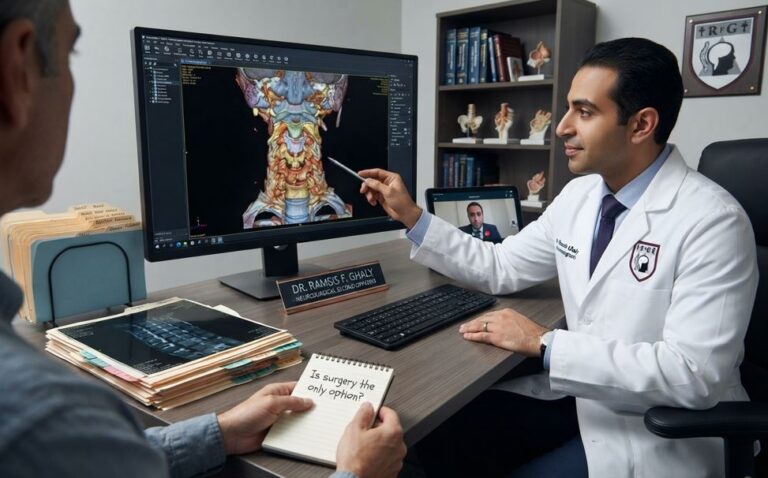
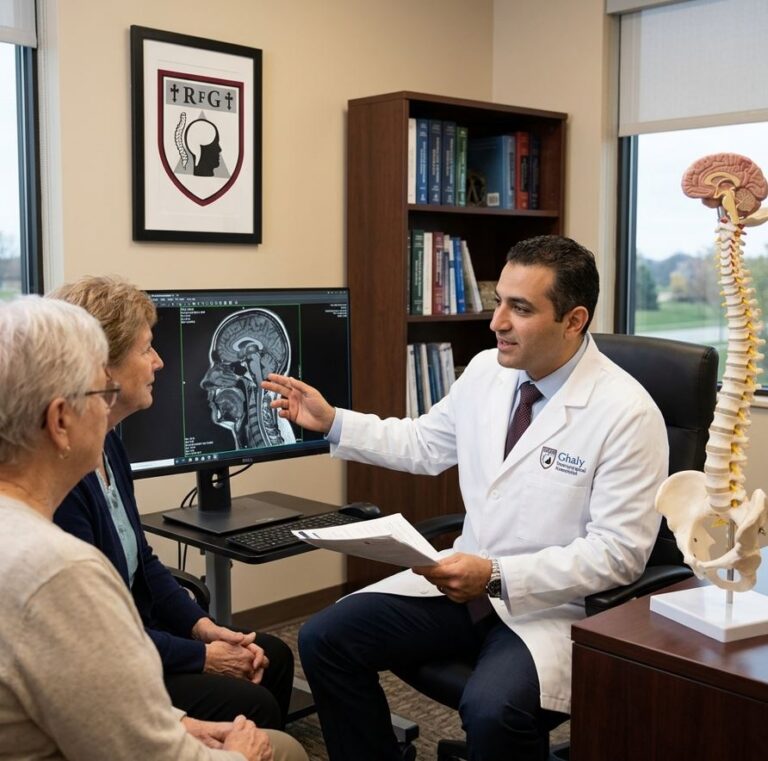
- Second Opinion Consultation: With your full history organized, Dr. Ghaly reviews your case personally and provides an independent clinical recommendation in person at the Aurora office, or through a secure virtual visit.
- Clear Next Step: You leave with a documented understanding of your diagnosis, your options, and whether surgery is genuinely the right path.
This is exactly the sequence many patients with complex neurological or neurosurgical histories follow start broad, then narrow to a decision.
Learn more about Medical Records Review → | Learn more about Second Opinion Consultations →
Conditions Where This Distinction Matters Most
This question comes up most often for patients dealing with:
- Brain conditions: brain tumors, aneurysms, hemorrhage, Chiari malformation, traumatic brain injury, or a craniotomy recommendation see Brain Surgery services →
- Spine conditions: spinal fusion, cervical or lumbar spine surgery, spinal stenosis, herniated or bulging discs, cervical laminectomy see Spinal Surgery services →
- Peripheral nerve conditions: carpal tunnel syndrome and ulnar nerve conditions see Carpal Tunnel & Peripheral Nerve Surgery →
In each of these areas, a records review can bring together scattered imaging and notes from multiple providers, while a second opinion can confirm whether the recommended procedure is truly the right or only option.
Do I Need to Travel to Aurora, IL for Either Service?
No. Both services are available remotely. Patients throughout the United States and internationally can submit records and imaging and, if appropriate, complete a second opinion consultation through a secure video visit rather than traveling to the Aurora office. Learn more about Telehealth Services →
Please note: virtual second opinion consultations are generally an out-of-pocket expense not billed through insurance, while in-person second opinions are typically billed like a standard office visit. Contact the office directly to confirm what applies to your specific plan.
FAQs
Is a medical records review the same as a second opinion?
No. A records review organizes and evaluates the medical information you already have. A second opinion is a new, independent clinical diagnosis and treatment recommendation, often built on top of that reviewed information.
Do I need a referral for either service?
No referral is required to request a medical records review or a second opinion from Dr. Ghaly, though bringing your existing imaging and records will make either process more thorough.
Can a records review help me avoid unnecessary surgery?
Yes. One of the most common reasons patients request a records review is to confirm whether a recommended surgery is genuinely necessary, or to catch something that may have been missed across their prior records.
If I start with a records review, can I move into a second opinion afterward?
Yes. Many patients start with a records review to get their history organized, then schedule a formal second opinion consultation with Dr. Ghaly once their case is fully documented.
Will insurance cover a records review or a second opinion?
Medical records reviews are typically out-of-pocket. For second opinions, in-person visits are usually billed through insurance like a standard consultation, while virtual second opinions are generally out-of-pocket. Contact the office to confirm coverage for your specific plan.
What if my insurance requires a specific provider?
You have the right to advocate for your own care. Reviewing your policy for out-of-network benefits, or considering a virtual second opinion as an out-of-pocket option, are both ways to get an independent evaluation even when a plan mandates a specific in-network provider.
What conditions does this apply to?
Primarily brain, spine, and peripheral nerve conditions including brain tumors, spinal fusion recommendations, herniated discs, and carpal tunnel or ulnar nerve conditions though Dr. Ghaly is qualified to review records for other conditions as well.
Still have questions?
We are here to help you understand which review process fits your situation. Contact Our Office →
You do not have to navigate this alone. Whether you need your records organized or an independent expert opinion before a major decision, Dr. Ghaly personally reviews every case.
Request an Appointment Online → or call 630-978-6143 / 630-578-7500.