Open vs. Endoscopic Carpal Tunnel Surgery: Which Approach Is Right for You?
If you have been told you need carpal tunnel surgery, one of the first questions is how the operation will be done. The two main techniques are open carpal tunnel release and endoscopic carpal tunnel release.
Neither approach is better for every patient. Both procedures do the same job. They divide the transverse carpal ligament to take pressure off the median nerve, and both work well over the long term. Endoscopic release often means smaller incisions, less scar tenderness and a quicker early recovery. Open release gives the surgeon a direct view of the nerve and is often favored after previous wrist surgery or when the anatomy is unusual. The best choice depends on your anatomy, how severe the nerve compression is, your surgical history and your surgeon’s experience with each technique.
This guide explains how each technique works, what research shows about recovery and risks, who may be a better candidate for each, and what to ask before you decide. Dr. Ramsis F. Ghaly, a board certified neurosurgeon in Aurora, IL, offers both approaches. If you want a personal recommendation, you can request an appointment or call 630-978-6143.
Open vs. Endoscopic Carpal Tunnel Release at a Glance
| Feature | Open release | Endoscopic release |
|---|---|---|
| Goal | Divide the transverse carpal ligament to relieve pressure on the median nerve | Same goal |
| Incision | One small incision in the palm (some surgeons use a shorter “mini-open” incision) | One small incision near the wrist (single-portal) or two small incisions at the wrist and palm (two-portal) |
| How the surgeon sees | Directly, through the incision | Through a small camera on a specialized instrument |
| Early recovery | Incision tenderness often lasts longer | Often less early pain and a quicker return to everyday activities |
| Long-term results | Excellent | Excellent; results are often similar to open release by about one year |
| Scar tenderness and “pillar pain” | More common in many studies | Less common in many studies |
| Rare complications | Low overall | Low overall; some studies report slightly more temporary nerve irritation or repeat surgery, while others find no significant difference |
| Often favored when | There was prior wrist surgery, anatomy is unusual, something needs to be explored, or the view is limited | The case is straightforward and a faster early recovery is a priority |
| Equipment and training | Widely performed | Requires specialized equipment and surgeon training |
This table describes general patterns. Your own situation may differ, which is why the technique should be chosen after an individual evaluation.
What Carpal Tunnel Release Surgery Actually Does
Carpal tunnel syndrome develops when the median nerve is squeezed as it passes through the carpal tunnel, a narrow passage in the wrist. It typically causes numbness, tingling, burning or pain in the thumb, index finger, middle finger and part of the ring finger. Symptoms are often worse at night and can make gripping, typing, driving and sleeping harder. In more advanced cases, the muscles at the base of the thumb can weaken or shrink.
The roof of the tunnel is a tough band called the transverse carpal ligament. Carpal tunnel release cuts this ligament so the nerve has more room. That is true whether the surgeon works through an open incision or with an endoscope. The only real difference is how the surgeon reaches the ligament.
Most carpal tunnel releases are done as outpatient procedures with local anesthesia, sometimes combined with light sedation. Surgery is usually considered when symptoms continue despite nonsurgical care, when they significantly disrupt daily life or sleep, or when your exam and nerve testing show significant or worsening nerve damage.
How Open Carpal Tunnel Release Works
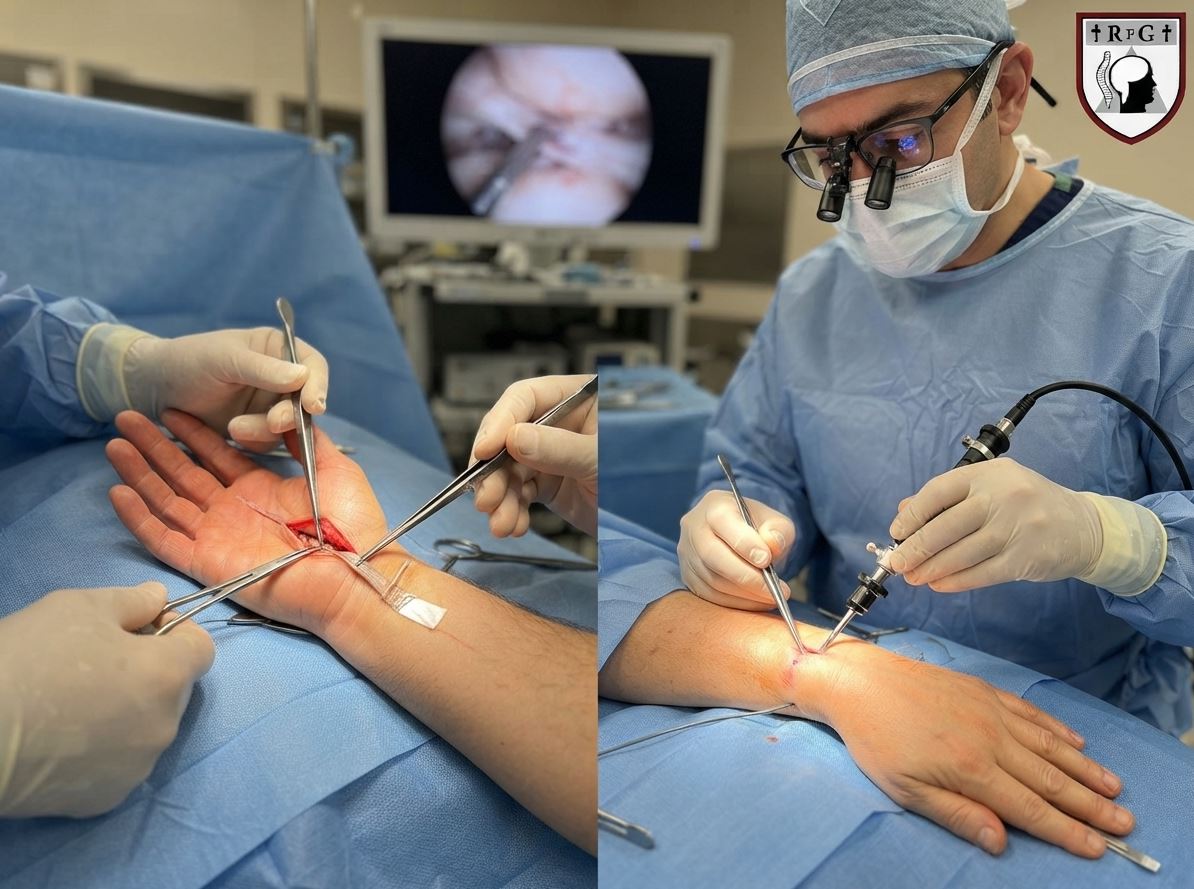
In open carpal tunnel release, the surgeon makes a small incision in the palm, directly over the carpal tunnel. The transverse carpal ligament is visible through the incision and is divided under direct view. The skin is then closed and a soft dressing is applied.
Open release has been used for decades and is a well-established, effective operation. Because the surgeon can see the ligament, nerve and surrounding structures directly, it is often chosen when a direct approach is preferred, when the anatomy is not typical, or when a surgeon needs to look at or treat something else inside the tunnel.
The trade-off is the incision location. The palm is a sensitive, high-use area, so scar tenderness and soreness when pressing or gripping can last longer for some patients.
How Endoscopic Carpal Tunnel Release Works
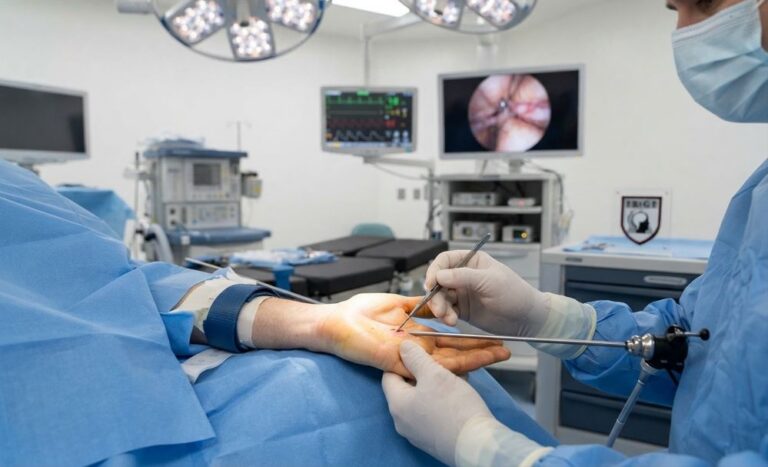
Endoscopic carpal tunnel release uses a small instrument with a camera and a protected blade. The surgeon watches the ligament on a screen and divides it from the inside, leaving the skin and soft tissue of the palm largely undisturbed.
There are two common variations:
- Single-portal: one small incision near the wrist crease.
- Two-portal: two small incisions, one at the wrist and one in the palm.
Because less tissue is disturbed, many appropriately selected patients have less early discomfort and return to certain activities sooner. The technique does demand specialized equipment and experience. If the surgeon cannot see the structures clearly during the procedure, switching to an open approach is a recognized and appropriate safety step.
If you are comparing options, you can learn more about both techniques on our carpal tunnel surgery page.
What the Research Shows
This has been studied extensively, including in randomized trials and meta-analyses. The overall picture is more nuanced than “endoscopic is better” or “open is safer.”
Recovery speed and early pain
A 2020 meta-analysis of randomized controlled trials published in BMC Musculoskeletal Disorders found that endoscopic release was associated with higher patient satisfaction, greater key pinch strength, earlier return to work and fewer scar-related problems. A separate randomized trial of 72 patients found faster symptom and functional improvement with endoscopic release during the first two weeks, mainly because pain settled sooner.
How much sooner varies. Estimates of the difference in return-to-work time range from about a week to several weeks depending on the study and the type of job. Patients with desk-based work often notice the least difference, while people who grip, lift or use vibrating tools may notice more.
Long-term results
By about one year, both techniques tend to give similar relief of numbness, tingling and night symptoms. In the same randomized trial, the two groups improved equally on nearly every measure at one year. That is reassuring: the technique you choose is less likely to decide your final outcome than whether you have the right diagnosis, the right timing and a surgeon experienced in the procedure.
Complications and repeat surgery
Serious complications are uncommon with either approach. Possible problems include scar tenderness, pillar pain (soreness on either side of the base of the palm), wound problems, stiffness and, rarely, injury to a nerve or blood vessel.
The evidence on rare complications is mixed. Some reviews report slightly more nerve injury or a higher need for repeat surgery after endoscopic release. A meta-analysis of randomized trials found no significant difference in permanent nerve injury between the two methods, and a large comparison of complications found no statistically significant difference in overall complication rates. Reviewers also note that endoscopic release is technically demanding and depends on surgeon experience, which is one reason to ask your surgeon how often they perform it.
Equipment and cost
Endoscopic release requires more specialized equipment and has a steeper learning curve for surgeons. Insurance coverage and out-of-pocket costs vary by plan and facility, so confirm details with your insurer before scheduling. Our office lists a billing and insurance contact on its website for these questions.
Not sure which option fits your hand? Talk with Dr. Ghaly about open vs. endoscopic release.
Who May Be a Better Candidate for Each Approach?
The final decision belongs to you and your surgeon after an exam and review of your history. These are general patterns, not rules.
Endoscopic release may be a good fit if:
- Your carpal tunnel syndrome is uncomplicated and has not had surgery before
- Your anatomy allows a clear view of the ligament
- A smaller incision and quicker early recovery matter for your work or daily routine
- Your surgeon regularly performs the technique
Open release may be a better fit if:
- You have had previous wrist or carpal tunnel surgery, or symptoms have returned
- You have unusual anatomy, scar tissue, or a possible mass or swelling in the wrist
- Your surgeon needs to look at or treat something else inside the tunnel
- Your nerve has been compressed for a long time and the surgeon wants maximum direct visibility
- Your surgeon is more experienced with open release
In some cases, a surgeon starts with the endoscopic approach and converts to open if the view is not good enough. Planning for that possibility is a normal part of safe surgery.
What Recovery Looks Like After Each Technique
Recovery varies with your age, job, overall health and the technique used. The ranges below are general guidance drawn from published patient information and studies, not a promise. Your surgeon will give you instructions specific to your procedure.
| Timeframe | What many patients experience |
|---|---|
| First 1–2 days | Hand elevated, gentle finger movement encouraged, soft dressing in place. Many people can do light, desk-type tasks within days |
| First 2 weeks | Incision heals. Some soreness and tenderness near the incision, often lasting longer after open release. Avoid forceful gripping |
| 2–4 weeks | Heavy lifting is usually still limited until the wound has healed. Light activity increases. Endoscopic patients are often further along at this point |
| 4–6 weeks | Gradual return to normal daily use. Manual or repetitive work often returns later |
| Several months | Grip strength, scar tenderness and fine motor control continue to improve. This phase is often slower after open release |
Numbness and tingling may not disappear right away. Nighttime symptoms often improve first, while long-standing numbness can take longer to fade, especially if the nerve was compressed for many months or years.
Call your surgeon promptly if you notice fever, increasing redness or drainage at the incision, bleeding that does not stop, or numbness that suddenly gets worse.
Do You Need Surgery at All?
Not everyone with carpal tunnel syndrome needs an operation. Many people improve with night splinting, activity changes, therapy or a corticosteroid injection. Surgery becomes more appropriate when those measures fail, when symptoms are severe, or when testing shows ongoing or significant nerve damage.
The diagnosis matters just as much as the technique. Numbness in the hand can also come from the ulnar nerve at the elbow or from a pinched nerve in the neck, and those conditions need different treatment. A careful neurological evaluation, often including nerve conduction testing, helps confirm what is actually causing your symptoms. If your symptoms might involve the neck, learn more about our spine surgery services.
Questions to Ask Before You Choose a Technique
Bringing these questions to your consultation can make the decision clearer:
- Which technique do you recommend for my hand, and why?
- How often do you perform open and endoscopic release?
- What would make you switch from endoscopic to open during surgery?
- Has my diagnosis been confirmed with an exam and nerve testing, and could anything else be contributing?
- What recovery should I expect for my job, including typing, driving and lifting?
- What are the risks that apply to me specifically?
- What is the plan if my symptoms do not improve?
How Dr. Ghaly Approaches the Open vs. Endoscopic Decision
Dr. Ramsis F. Ghaly is a board certified neurosurgeon with decades of surgical experience treating conditions of the brain, spine and peripheral nerves. Because carpal tunnel syndrome is a nerve compression problem, evaluating it is a natural part of his work with the nervous system.
He offers both open and endoscopic carpal tunnel release, and he does not treat the smallest incision as the automatic winner. The goal is to match the technique to your anatomy, the severity of nerve compression, any previous procedures and other clinical factors. He also explains nonsurgical options, and he recommends surgery only when it is the right step for the individual patient.
Dr. Ghaly sees patients at Ghaly Neurosurgical Associates in Aurora, IL, including people from Naperville and across the greater Chicago area. The office is at Fox Valley Office Commons, 4260 Westbrook Dr., Suite 127, Aurora, IL 60504, close to the Fox Valley Mall.
Ready to talk through your options? Request an appointment online or call 630-978-6143. New patients should press 0.
Get a Second Opinion or Records Review From Anywhere
If another physician has recommended surgery and you are unsure about the need for surgery or the technique, an independent review can help you decide with confidence. Dr. Ghaly offers a dedicated medical second opinion service for patients who want an expert perspective before moving forward.
If you cannot travel to Aurora, you have remote options too:
- A telehealth consultation by secure video
- A medical records review of your nerve testing, imaging, prior surgical records and treatment history
To get more from your review, see what to expect in what happens during a medical records review and read why a second opinion can be a good idea before major surgery.
FAQs
Is endoscopic carpal tunnel surgery better than open surgery?
Not automatically. Endoscopic release often brings less early pain and a quicker return to activity, while both techniques usually give similar long-term relief. Open release remains an effective standard approach and is often preferred after previous surgery or when anatomy is unusual. The better option is the one that is safest and most effective for your hand.
Which has a faster recovery, open or endoscopic carpal tunnel release?
Endoscopic release is generally associated with faster early recovery, including less scar tenderness and an earlier return to certain activities. The advantage tends to narrow over time, and by about one year the results are often similar.
Is endoscopic carpal tunnel release safer than open release?
Neither is clearly safer for everyone. Serious complications are uncommon with both. Endoscopic release has fewer scar-related problems, while some studies report slightly more nerve irritation or repeat surgery with endoscopic release. Surgeon experience and careful patient selection matter a great deal.
Does endoscopic carpal tunnel release have a higher failure or repeat surgery rate?
Results vary by study. Some reviews report a higher chance of repeat surgery after endoscopic release, often linked to an incomplete release of the ligament, while others find no significant difference. Both techniques can occasionally leave symptoms that persist or return, which is why a careful diagnosis and an experienced surgeon are so important.
How big is the incision, and will I have a scar?
Open release uses a small incision in the palm, sometimes shortened in a “mini-open” approach. Endoscopic release uses one incision near the wrist or two small incisions at the wrist and palm. Scars usually fade, but palm scar tenderness is more common after open release.
Why would a surgeon choose open instead of endoscopic?
A surgeon may prefer open release for revision surgery, unusual anatomy, scar tissue, a suspected mass, or when a clear camera view is not possible. Some surgeons also choose open release because it is the technique they are most experienced with.
Can an endoscopic procedure be changed to open during surgery?
Yes. If the surgeon cannot see the structures clearly or safely complete the release endoscopically, switching to an open approach is an accepted safety measure. This is why you should discuss that possibility before surgery.
When can I return to work or drive after carpal tunnel surgery?
Many people with desk-based jobs return to light tasks within days, while heavy or repetitive work usually takes longer. Driving depends on pain level, which hand was treated and your surgeon’s guidance. Your timeline may be shorter after endoscopic release, but follow your surgeon’s instructions for your specific case.
Is a neurosurgeon qualified to perform carpal tunnel surgery?
Yes. Carpal tunnel syndrome is a compression of the median nerve, and neurosurgeons are trained in nerve and nervous system conditions. Dr. Ghaly evaluates and treats carpal tunnel syndrome and other peripheral nerve conditions as part of his neurosurgical practice.
Does insurance cover open and endoscopic carpal tunnel release?
Coverage depends on your plan, your diagnosis and the facility. Contact your insurer before scheduling. For billing and insurance questions related to Ghaly Neurosurgical Associates, call HealthPCP at 708-532-6029.
Take the Next Step
Choosing between open and endoscopic carpal tunnel release does not have to be a guess. A thorough evaluation can confirm your diagnosis, review your nerve testing and explain which approach makes the most sense for your hand and your life.
Request an appointment with Dr. Ghaly or call 630-978-6143 (Monday to Friday, 9:00 AM to 5:00 PM). Prefer to start from home? Ask about a telehealth consultation or a medical records review.