What Records Do You Need for an Online Neurosurgery Consultation?
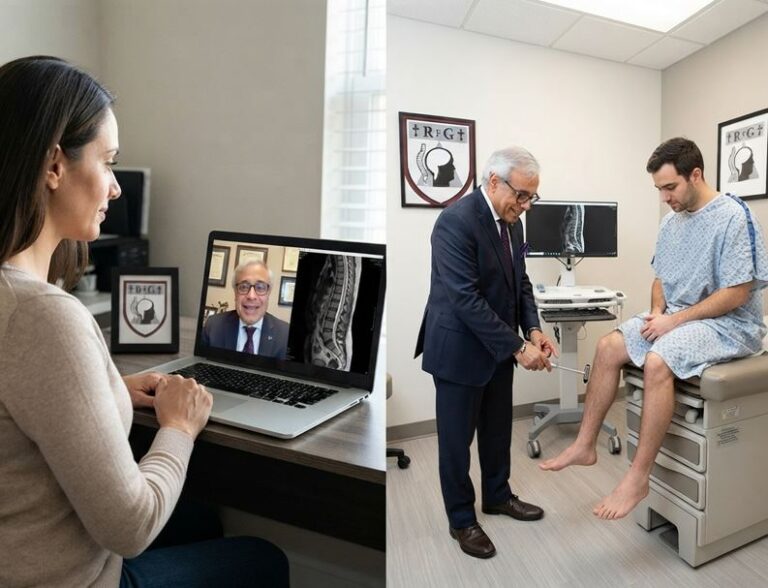
Getting a virtual appointment on the calendar is the easy part. What actually determines whether your online neurosurgery consultation is useful is what Dr. Ghaly has in front of him when the call starts. A telehealth visit can’t include a hands-on neurological exam, so imaging, records, and history have to do more of the work than they would at an in-person visit.
This guide walks through exactly what to gather before a virtual neurosurgeon consultation whether you’re scheduling a telehealth visit, requesting a medical second opinion, or starting with a standalone medical records review.
What You Need at a Glance
For most online neurosurgery consultations, you should have the following ready before your visit:
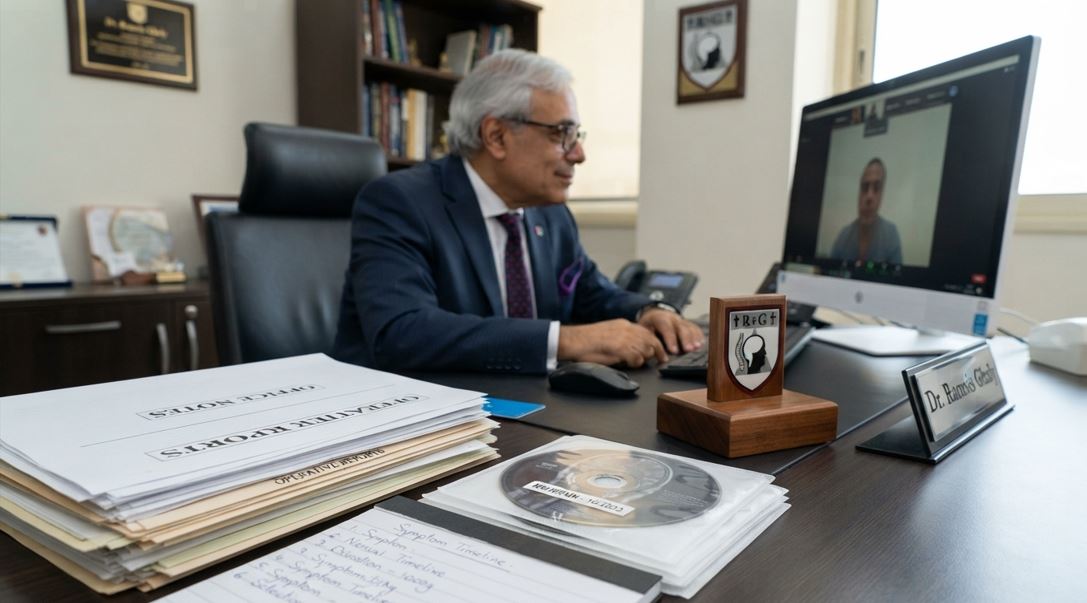
- Imaging MRI, CT, and/or X-ray files (not just the written report), ideally the actual images on disc or as a digital file
- Radiology reports the written interpretation that came with each imaging study
- Office notes from any doctor who has already evaluated your condition
- Operative reports, if you’ve had any prior brain, spine, or nerve surgery
- A list of current medications and dosages
- Known allergies, especially to medications or contrast dye
- Diagnostic test results EMG/nerve conduction studies, lab work, biopsy results if applicable
- A brief symptom timeline when symptoms started, how they’ve changed, what’s been tried
- Insurance information, if your visit will be billed to insurance
- Completed patient intake forms, submitted ahead of time
Not every item applies to every patient. A carpal tunnel follow-up needs far less than a brain tumor second opinion. The sections below break this down by situation.
Ready to start? Request your telehealth appointment and the office will confirm exactly which of these apply to your case.
Why Records Matter More in a Virtual Visit
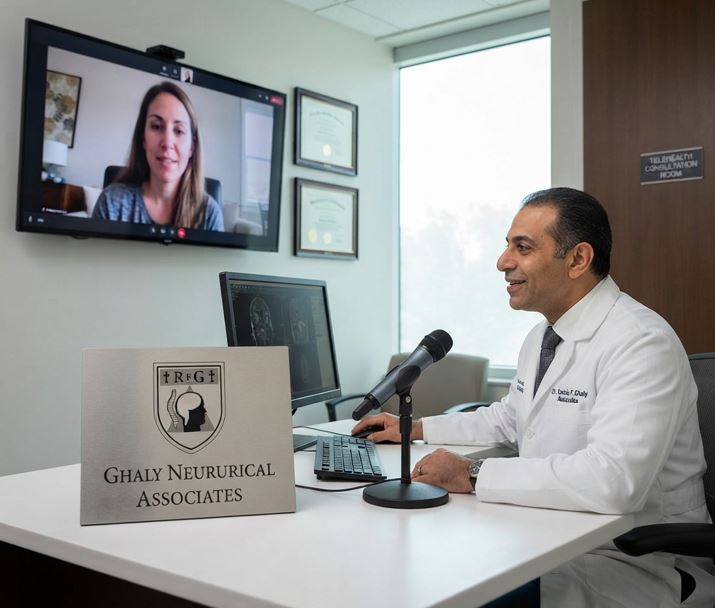
An in-person visit gives a neurosurgeon two sources of information: what you say, and what a physical exam shows. A virtual visit removes the second one. As explained on Dr. Ghaly’s telehealth, an online neurosurgeon consultation is highly effective for reviewing history, imaging, and follow-up care but it depends on that imaging and history actually being available to review. Without it, a virtual visit becomes a conversation about symptoms in the abstract rather than a real clinical evaluation of your case.
This is also why records matter more for neurosurgery specifically than for many other specialties. Conditions like herniated discs, brain tumors, spinal stenosis, or carpal tunnel syndrome are diagnosed largely from imaging and nerve studies, not from symptoms alone. Two patients with identical complaints of arm numbness can have completely different underlying causes and completely different treatment recommendations depending on what an MRI or EMG shows.
What to include, by condition:
| Condition Type | Imaging Typically Needed |
| Brain (tumor, aneurysm, Chiari, TBI) | Brain MRI with and without contrast (if performed), CT if done, any prior post-op imaging |
| Spine (herniated disc, stenosis, fusion recommendation) | MRI of the relevant spine region (cervical/thoracic/lumbar), CT or X-ray if performed, flexion/extension X-rays if ordered |
| Carpal tunnel / peripheral nerve | EMG/nerve conduction study results (imaging is less central here than nerve studies) |
If you only have the radiology report and not the images themselves, send it anyway it’s still useful but plan to request the actual imaging as a next step. This is exactly the kind of gap Dr. Ghaly’s medical records review service is built to catch before your consultation.
1. Imaging: MRI, CT, and X-Ray Files
This is the single most important category, and the one patients most often get wrong.
Send the actual images, not just the report. A radiology report tells the reviewing neurosurgeon what someone else concluded. The actual imaging (the DICOM files) lets Dr. Ghaly look at the scan directly and form his own clinical impression which is often the entire point of seeking a second opinion.
How to get your imaging:
- Call the medical records or film library department of the facility where the scan was performed
- Request the images on a CD/DVD or ask if they can transmit them electronically (many imaging centers now use platforms like PACS, lifeIMAGE, or Ambra for direct digital transfer)
- You may need to sign a Release of Medical Information / Release of Confidential Health Information form at that facility
Timing matters. For active or changing conditions (brain tumors, aneurysms, new spine symptoms), imaging within the last 6–12 months is generally most useful. Older imaging can still add value for comparison, especially to show whether a condition is progressing, so send what you have even if it’s not recent.
2. Physician Notes, Operative Reports & Referral Information
Imaging tells part of the story; what other physicians have already documented tells the rest.
Gather, where available:
- Office notes from your primary care physician, neurologist, orthopedic surgeon, or any specialist who has evaluated this condition
- Operative reports from any prior brain, spine, or nerve surgery, including the surgeon’s post-op notes
- Referral letters, if a physician referred you specifically for a neurosurgical opinion (many patients can also schedule directly without one)
- Discharge summaries, if your condition involved a hospital stay
If you’ve seen multiple providers or gotten more than one recommendation, don’t try to summarize it yourself and send what you have from each one. Reconciling conflicting information across providers is a normal part of a neurosurgical second opinion, and having the original documentation lets Dr. Ghaly see where the recommendations actually differ.
3. Diagnostic Test Results
Beyond imaging, include any of the following that apply to your case:
- EMG / nerve conduction study (NCS) results essential for carpal tunnel, ulnar neuropathy, and other peripheral nerve evaluations
- Lab work, if it relates to your neurological condition
- Biopsy or pathology reports, for brain tumor cases
- Bone density or other spine-relevant testing, if performed
4. Medication List & Allergies
A simple but often-skipped item. Prepare:
- Current medications and dosages (including over-the-counter and supplements)
- Any prior medications tried for this condition and whether they helped
- Known drug allergies
- Allergy to contrast dye, if applicable (relevant if further imaging is being considered)
5. Your Symptom Timeline
Before your visit, write out (even briefly):
- When symptoms started
- How they’ve changed better, worse, stable
- What makes them better or worse
- What treatments you’ve already tried (physical therapy, injections, medications, prior surgery)
- What you were told needs to happen next, if anything
This isn’t a formal “record,” but it is one of the most useful things you can bring. It gives Dr. Ghaly the clinical narrative behind the imaging, and it helps you stay organized during the call instead of trying to recall dates and details on the spot.
6. Insurance Information & Completed Forms
Insurance handling depends on the type of visit:
- In-person visits and many telehealth visits are typically billed through insurance like a standard appointment
- Virtual second opinions are generally an out-of-pocket service, not billed through insurance as noted on the second opinion page
- Medical records review is also an out-of-pocket service, which allows the review to happen without insurance restrictions or time limits
You should also complete the relevant patient forms in advance:
- Health Insurance Registration Form
- Release of Confidential Health Information Form needed if the office will be requesting records directly from another provider on your behalf
- Health Assessment Form
- VA/WC Registration Form, if applicable
- Disclosure to Friends & Family Form, if you want a family member included in your care conversations
You can also download the full forms package at once.
How to Send Your Records Securely
- Request records from each source directly. Contact the medical records department at each hospital, imaging center, or physician’s office. Most can transmit records and imaging electronically once you sign a release.
- Complete the release of information form. This authorizes another provider to send your records to Dr. Ghaly’s office, and speeds up the process considerably.
- Fill out the contact form. Start at drramsisghaly.com/contact-dr-ghaly with your information and reason for the visit.
- Wait for office instructions. After your initial phone call with the office, you’ll receive specific instructions for how to submit your imaging and records securely.
- Confirm everything was received before your scheduled visit, so there’s time to track down anything missing.
What If You’re Missing Some Records?
This is common, and it isn’t a reason to delay reaching out. Between multiple hospitals, imaging centers, and physicians, it’s normal for pieces of a medical history to be scattered or incomplete.
If you’re not sure what you have, what you’re missing, or whether your existing records are enough to make a confident decision, that’s precisely the gap a standalone medical records review is designed to close. Dr. Ghaly personally reviews what’s available, organizes it into a clear timeline, and identifies missing records or imaging before you commit to a consultation so you’re not paying for a visit that gets cut short by incomplete information.
Telehealth vs. Second Opinion vs. Records Review: Which Do You Need?
These three services often get confused, but they solve different problems and require slightly different preparation.
| Telehealth Consultation | Second Opinion | Medical Records Review | |
| Best for | Initial visits, follow-ups, post-op check-ins | Confirming or challenging a surgery recommendation | Organizing scattered records before deciding on next steps |
| Format | Live video or phone visit | In-person or virtual visit | Document/imaging review, may lead to a consultation |
| Records needed | Imaging + history relevant to your visit reason | Full imaging, prior treatment records, current surgical recommendation | Everything available records review helps identify what’s missing |
| Typical starting point | You know what you want to discuss | You’ve already been told you need surgery | You’re not sure what you have or what it all means |
If you’re unsure which fits your situation, start with the contact form and describe where you are in the process. The office can help direct you to the right format.
Records Checklist by Specialty
Brain conditions (tumor, aneurysm, Chiari malformation, TBI): Brain MRI with/without contrast, CT if performed, radiology reports, any prior craniotomy operative report, current neurological symptoms and timeline.
Spine conditions (herniated disc, spinal stenosis, fusion recommendation): MRI of the affected spine region, X-rays if performed (including flexion/extension views if ordered), any prior spine surgery operative report, physical therapy or injection history.
Carpal tunnel & peripheral nerve conditions: EMG/nerve conduction study results, any prior wrist or nerve imaging, history of splinting, injections, or prior nerve surgery.
Step-by-Step: Preparing for Your Online Consultation with Dr. Ghaly
- Request an appointment through the online contact form or by calling 630-978-6143.
- Receive a brief initial phone call from the office to confirm telehealth is the right fit for your situation.
- Gather and submit your imaging, records, and completed forms using the instructions the office provides.
- Have Dr. Ghaly personally reviews your case before your scheduled visit, not a delegate or third-party service.
- Attend your virtual visit from a computer, tablet, or smartphone with internet access no special software required.
- Leave with a clear next step: a treatment plan, a recommendation for further imaging, or guidance on whether an in-person visit is needed.
Request Your Online Neurosurgery Consultation →
Frequently Asked Questions
Do I need a referral for an online neurosurgery consultation?
No referral is required in most cases and many patients schedule directly. If a physician did refer you, bringing that referral letter along with your records can still help.
What if I don’t have my imaging on a CD, only a paper report?
Send the report it’s still useful context but plan to request the actual imaging files from the facility that performed the scan, since the images themselves give Dr. Ghaly the ability to form his own clinical impression rather than relying only on someone else’s interpretation.
How old can my MRI or CT scan be and still be useful?
Imaging within the last 6–12 months is generally most relevant for active symptoms, but older imaging is still valuable for comparison, especially to show whether a condition has changed over time. Send what you have.
Is a virtual consultation as thorough as an in-person visit?
A virtual neurosurgeon consultation is highly effective for reviewing history, imaging, and follow-up care. Some conditions, particularly new or rapidly changing symptoms are best evaluated with an in-person physical exam for the most accurate diagnosis.
Will my insurance cover the cost of a telehealth visit or second opinion?
It depends on the service. In-person visits and many telehealth visits are typically billed like a standard appointment. Virtual second opinions and medical records review are generally out-of-pocket services. Call HealthPCP at 708-532-6029 to confirm your specific coverage.
What if my records are spread across multiple hospitals or doctors?
This is common. Send whatever you have from each source, and consider starting with a medical records review, which is specifically designed to organize scattered records into one clear picture before your consultation.
Can I still get a consultation if I’m missing some records?
Yes. Reach out and share what you have. The office can advise on what’s still needed and how to obtain it before or shortly after your scheduled visit.
Do you accept patients from outside Illinois or the U.S.?
Yes. Telehealth, second opinion, and medical records review services are available to patients throughout the United States and internationally.
You do not have to organize this alone. If you’re unsure what you have, what’s missing, or where to start, contact Dr. Ghaly’s office and the team will walk you through exactly what’s needed for your specific situation.